
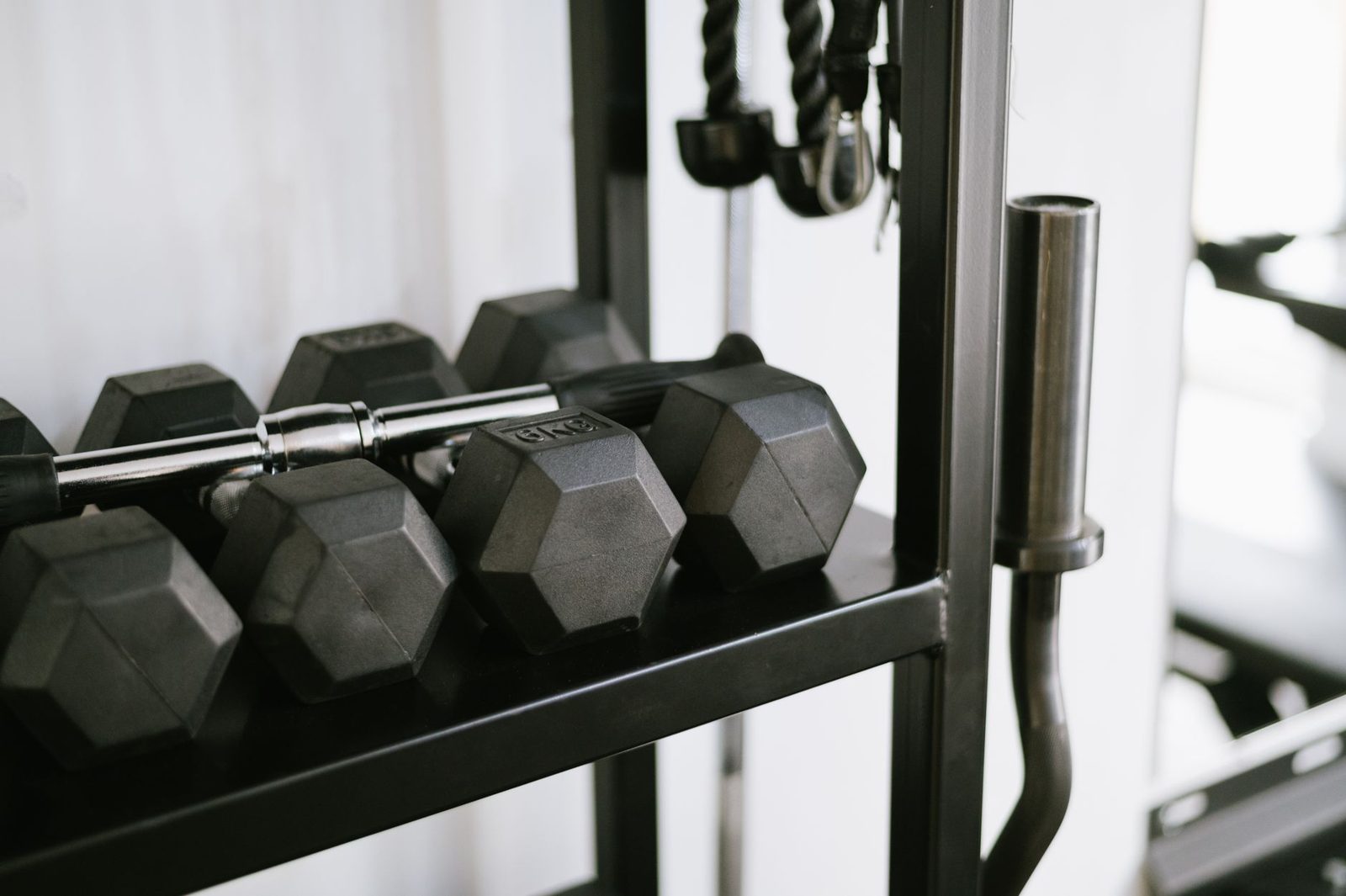
Quick answer: choose a dumbbell you can lift for your target number of reps, usually 8 to 12 for beginners, with good form and about two or three reps left in reserve. You will need different weights for different exercises: heavier for squats, lunges and rows, lighter for shoulder raises and arm work. When you can beat your target by one or two reps on every set, move up.
Why there is no single right weight
A weight that is heavy for a lateral raise may be light for a goblet squat. Your legs, hips and back are large, strong muscle groups, while your shoulders and arms are smaller. So the question is not what weight dumbbell you need, but what weight you need for each exercise. That is why many home lifters end up with at least two or three pairs, or an adjustable set.
The rep test
The most practical way to pick a weight is to test it against a rep target. The NHS suggests 8 to 12 repetitions per set, with at least 2 sets and 3 for more benefit. The American College of Sports Medicine’s 2009 position stand recommends that novices use loads corresponding to an 8 to 12 repetition maximum.
- Pick the exercise and a weight you think is manageable.
- Do as many good reps as you can while keeping perfect form, but stop when you sense you have two or three left.
- If you stopped before 8 reps, the weight is too heavy for now. If you easily passed 12 and still had plenty left, it is too light.
- Adjust and test again in your next session rather than chasing it all in one day.
Understanding reps in reserve
Reps in reserve (RIR) means how many more good reps you could have done at the end of a set. ACSM’s 2026 guidance says training near failure, roughly two to three reps in reserve, gives similar strength and muscle gains to taking every set to failure, with less fatigue and lower injury risk. A 2024 study by Refalo and colleagues found that trained lifters could predict one and three reps in reserve with high accuracy, typically within about one rep. Beginners tend to underestimate how much they have left, so it is a skill to practise.
| How the last rep felt | Approximate reps in reserve | What to do |
|---|---|---|
| Could easily have done 5 or more | 5+ | Too light, go up a weight or add reps |
| Could have done 3 or 4 more | 3 to 4 | Good for learning technique; progress soon |
| Could have done 2 or 3 more with good form | 2 to 3 | The target zone for most working sets |
| Could have done 1 more at most | 1 | Hard; fine occasionally for experienced lifters |
| Form broke down or rep was missed | 0 | Too heavy; reduce the weight |
Relative weights by exercise type
Rather than quote kilogram figures that would not suit everyone, it is more useful to think about which exercises need the heaviest and lightest dumbbells in your set.
| Exercise group | Examples | Relative load |
|---|---|---|
| Lower body, both legs | Goblet squat, Romanian deadlift | Heaviest in your set |
| Lower body, one leg | Split squat, reverse lunge, step-up | Heavy to moderate |
| Pulling | One-arm row | Heavy to moderate |
| Horizontal pushing | Floor press, bench press | Moderate |
| Vertical pushing | Overhead press | Moderate to light |
| Arms | Curls, triceps extensions | Light to moderate |
| Shoulder isolation | Lateral raise, rear delt raise | Lightest in your set |
Why dumbbells feel heavier than barbells
Do not be surprised if you cannot press as much with dumbbells as you can with a barbell. In a 2011 study by Saeterbakken and colleagues, trained men’s one-rep max on the dumbbell chest press was about 17% lower than on the barbell and 14% lower than on a Smith machine. Each hand has to stabilise its own weight, so a lighter dumbbell can still give a hard, productive set.
Heavy or light: does it matter?
A 2017 meta-analysis by Schoenfeld and colleagues found that muscle growth was similar across a wide range of loads when sets were taken to failure, but maximal strength improved more with heavier loads. ACSM’s 2026 guidance points to around 80% of one-rep max for strength work. For most home lifters, that means the 8 to 12 range is a sensible default, with lower rep, heavier sets added later if strength is the main goal.
When to move up a weight
ACSM’s 2009 guidance recommends a 2 to 10% increase in load once you can perform one or two reps more than your target. With dumbbells, the next weight up is often a bigger percentage jump than that, especially at lighter weights. If the jump feels too big:
- Keep the weight and add reps until you reach the top of your range on every set.
- Use the heavier weight for the first set only, then return to the lighter one.
- Slow the lowering phase to make the current weight more challenging.
A 2022 study by Plotkin and colleagues found that increasing reps at a fixed load and increasing load at fixed reps produced broadly similar results over eight weeks, so adding reps is a legitimate way to progress.
Signs the weight is wrong
- You swing or jerk the dumbbell to get it moving.
- Your back arches during presses, or rounds during rows and deadlifts.
- You cannot control the lowering phase.
- You feel it in your joints more than in the target muscles.
Building a sensible set
If you are buying fixed dumbbells, aim for a light, a medium and a heavy pair that match the exercise groups above, and plan to add heavier pairs as your legs and back get stronger. If space is tight, an adjustable set covers the range in one footprint. Either way, keep a log so you always know which weight to pick up next time.
Health note: this article is general education, not medical advice. If you have a health condition, an injury, are pregnant, or have not exercised for a long time, check with your GP or a physiotherapist before starting or changing a training plan, and stop if an exercise causes pain.
Sources
- How to improve your strength and flexibility, NHS (nhs.uk)
- ACSM position stand: Progression models in resistance training for healthy adults (2009), Medicine and Science in Sports and Exercise (europepmc.org)
- ACSM unveils landmark 2026 resistance training guidelines, American College of Sports Medicine (acsm.org)
- Refalo et al. (2024) Accuracy of intraset repetitions-in-reserve predictions during the bench press exercise, Journal of Strength and Conditioning Research (europepmc.org)
- Saeterbakken, van den Tillaar and Fimland (2011) A comparison of muscle activity and 1-RM strength of three chest-press exercises with different stability requirements, Journal of Sports Sciences (europepmc.org)
- Schoenfeld et al. (2017) Strength and hypertrophy adaptations between low- vs. high-load resistance training: a systematic review and meta-analysis, Journal of Strength and Conditioning Research (europepmc.org)
- Plotkin et al. (2022) Progressive overload without progressing load? The effects of load or repetition progression on muscular adaptations, PeerJ (europepmc.org)
Leave a Reply