
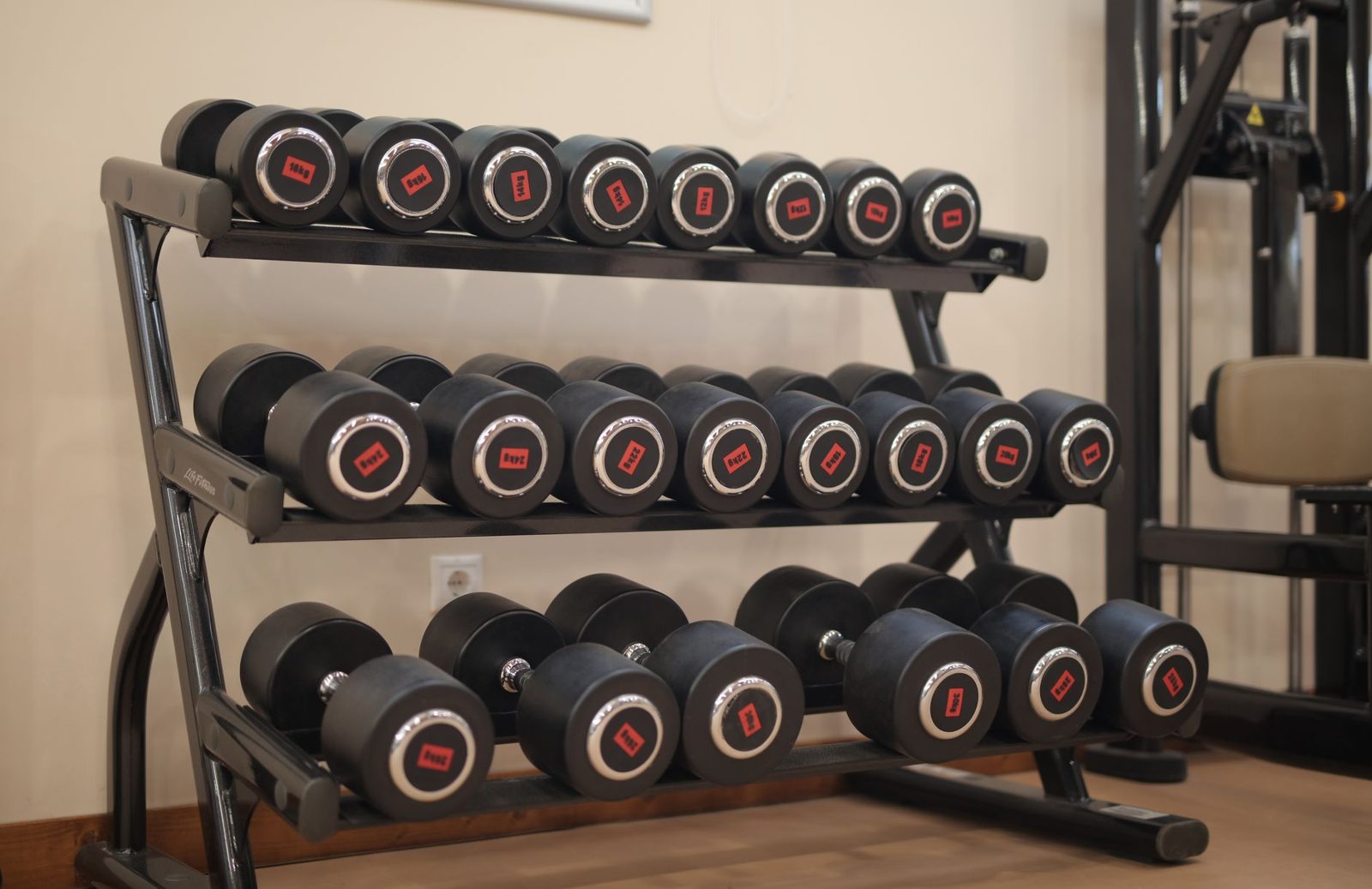
Quick answer: adjustable dumbbells give you a wide range of weights in a small footprint, which suits most home trainers with limited space. Fixed dumbbells are quicker to use, more robust and better if several people train at once or you like fast circuits. Research shows equipment type matters far less than training consistently, so pick the option that fits your space, budget, and how you like to train.
The key difference
A fixed dumbbell is one weight, permanently. An adjustable dumbbell lets you change the load, either by adding and removing plates secured with collars (spin-lock style), or by using a dial, pin or slide to select a stack of plates (selectorised style). Both let you train every muscle group; the difference is convenience, space and durability.
Why choice of equipment matters less than you think
ACSM’s 2026 resistance training position stand, based on 137 systematic reviews, emphasises that the biggest gains come from doing resistance training regularly, working all major muscle groups at least twice a week. One of its authors summed it up by saying the best programme is the one you will actually stick with. So the question is really which type of dumbbell you are more likely to use, week after week.
Head to head
| Factor | Adjustable | Fixed |
|---|---|---|
| Floor space | One pair and a stand or cradle | A rack for each set of pairs |
| Weight range | Wide range from one pair | Only the pairs you own |
| Speed of changing weight | Seconds for selectorised; slower for spin-lock | Instant, pick up the next pair |
| Weight steps | Set by the design, sometimes coarse | Set by which pairs you buy |
| Durability | Mechanisms need care; not for dropping | Very robust, especially rubber hex |
| Feel in the hand | Can be bulky or long at lighter settings | Compact at every weight |
| Multiple users at once | Awkward | Easy |
| Safety checks | Check collars or selector every set | Check heads are tight periodically |
The case for adjustable dumbbells
- Space: a single pair can replace a rack of many pairs, which matters in flats and spare rooms.
- Room to grow: progressive overload means you will need heavier weights over time. ACSM’s 2009 position stand recommends increasing load by 2 to 10% when you can beat your target reps by one or two, and adjustable sets make those steps available without buying new pairs.
- Different muscle groups: legs and back usually need more load than shoulders and arms, and an adjustable pair can cover all of them.
The case for fixed dumbbells
- Speed: for supersets, circuits or drop sets, grabbing the next pair is quicker than adjusting.
- Robustness: fixed dumbbells, especially rubber hex, tolerate everyday knocks better than mechanisms do.
- Handling: they are usually shorter and more compact, which helps with exercises where the dumbbell moves close to your body, such as goblet squats or lateral raises.
- Shared use: two people can train at once without waiting.
Safety with each type
An analysis of US emergency department cases by Kerr and colleagues found that weights dropping on people was the most common cause of weight training injuries, at 65.5% of cases, with 90.4% of injuries involving free weights. With adjustable dumbbells, the main risk is a plate coming loose, so:
- Check spin-lock collars are tight before every set; they can loosen as you train.
- Make sure a selectorised dial or pin is fully engaged and the dumbbell lifts cleanly from its cradle.
- Return selectorised dumbbells to their cradle carefully rather than dropping them.
With fixed dumbbells, the main risks are clutter and rolling. Rack them after each set, and choose hex heads if your floor is uneven.
Weight steps and progression
Look closely at how the weights increase. Small, even steps make it easier to progress gradually on smaller exercises such as shoulder raises. Larger steps can be fine for squats and deadlifts but may be too big a jump for lighter movements. If a step is too large, you can keep the weight and add reps until you are ready; a 2022 study by Plotkin and colleagues found that progressing reps at a fixed load produced broadly similar results to progressing load over eight weeks.
Care and maintenance
| Task | Adjustable | Fixed |
|---|---|---|
| Before each session | Check collars, selectors and plates | Quick visual check |
| After each session | Wipe handles; return to stand | Wipe handles; return to rack |
| Monthly | Inspect threads, pins and plate slots; follow maker’s guidance | Check heads are tight; look for cracked coatings |
| Storage | Dry, level surface; out of children’s reach | Rack or low shelf; dry space |
Questions to ask before you decide
- What will you train? The NHS recommends working the legs, hips, back, abdomen, chest, shoulders and arms on at least two days a week. List the exercises you plan to do and the rough weight range each needs.
- Where will the dumbbells live? Measure the space. A rack of fixed pairs needs more room than most people expect.
- How do you like to train? Straight sets with plenty of rest suit adjustable dumbbells well. Fast circuits and supersets favour fixed pairs.
- Who else will use them? Households with more than one lifter often find fixed pairs, or a mix, less frustrating.
- How heavy will you need to go? Check the maximum weight of any adjustable design against where you want your leg and back training to be in a year or two.
Which should you choose?
- Small space, one user, long-term progression: adjustable.
- Circuits, shared training, rough use: fixed.
- Best of both: an adjustable pair for heavier lifts plus one or two light fixed pairs for shoulder work and warm-ups is a popular combination.
The bottom line
Both types build strength and muscle. Choose based on space, how you train and who you train with, check your equipment regularly, and focus your energy on training consistently at least twice a week.
Health note: this article is general education, not medical advice. If you have a health condition, an injury, are pregnant, or have not exercised for a long time, check with your GP or a physiotherapist before starting or changing a training plan, and stop if an exercise causes pain.
Sources
- ACSM unveils landmark 2026 resistance training guidelines, American College of Sports Medicine (acsm.org)
- ACSM position stand: Progression models in resistance training for healthy adults (2009), Medicine and Science in Sports and Exercise (europepmc.org)
- Kerr, Collins and Comstock (2010) Epidemiology of weight training-related injuries presenting to United States emergency departments, 1990 to 2007, American Journal of Sports Medicine (europepmc.org)
- Plotkin et al. (2022) Progressive overload without progressing load? The effects of load or repetition progression on muscular adaptations, PeerJ (europepmc.org)
- Physical activity guidelines for adults aged 19 to 64, NHS (nhs.uk)
Leave a Reply