
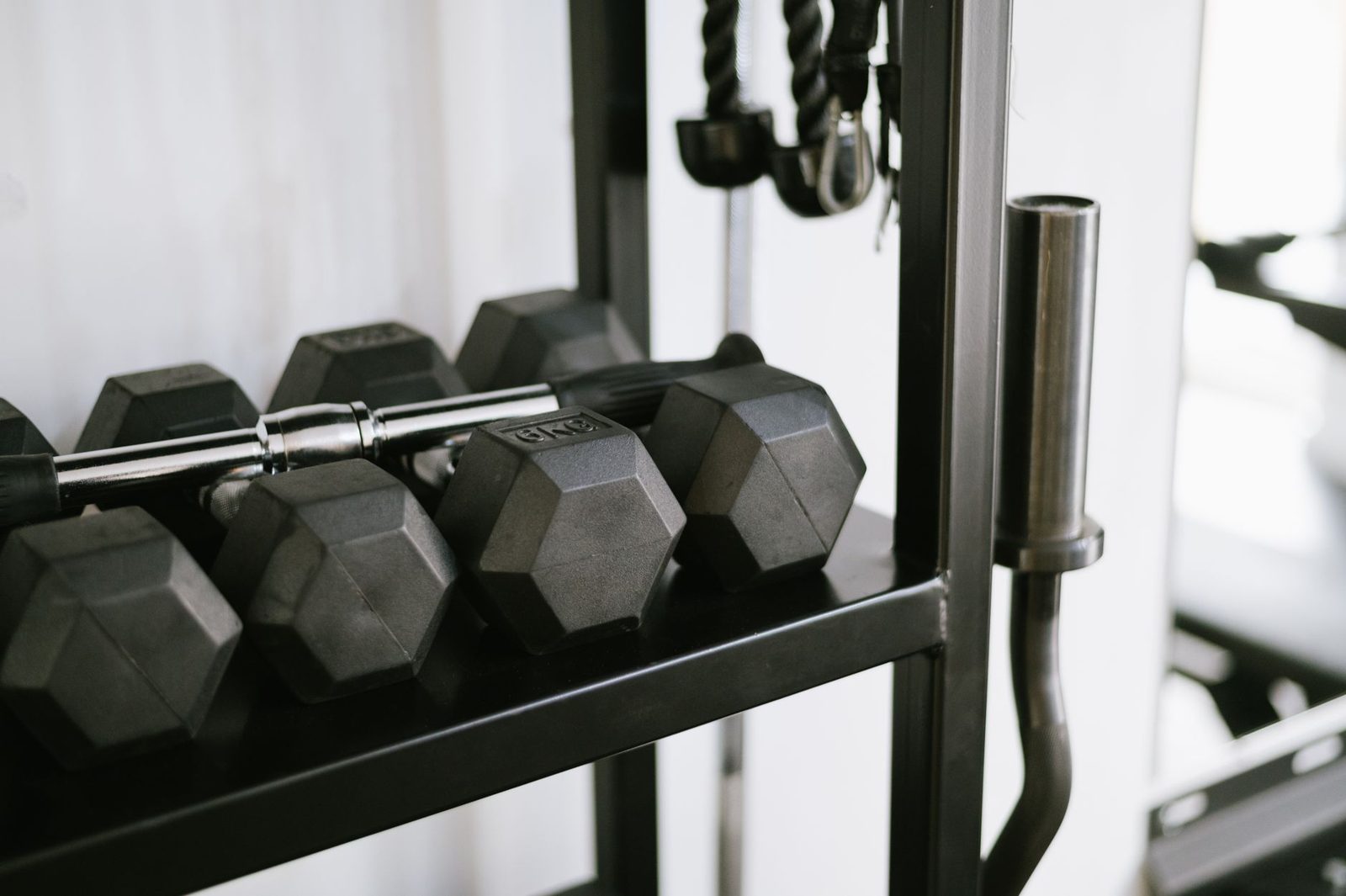
Quick answer: with a few pairs of dumbbells you can train every major muscle group the NHS lists: legs, hips, back, abdomen, chest, shoulders and arms. Use goblet squats and lunges for legs, Romanian deadlifts and hip thrusts for hips, rows for the back, presses for chest and shoulders, curls and extensions for arms, and carries for the trunk. Aim for around 10 weekly sets per muscle group once you are established.
How to use this guide
The NHS and the UK Chief Medical Officers recommend strengthening activities that work all major muscle groups on at least two days a week. This guide lists reliable dumbbell exercises for each group, with a short coaching cue for each. Choose one or two per group for each session and rotate them over time.
ACSM’s 2026 position stand suggests about 10 sets per muscle group per week for muscle growth. A 2017 meta-analysis by Schoenfeld, Ogborn and Krieger found a graded dose-response relationship between weekly sets and muscle growth. Beginners can start with fewer sets and build up.
Quick reference table
| Muscle group | Main exercise | Alternative | Key cue |
|---|---|---|---|
| Thighs (quadriceps) | Goblet squat | Split squat | Knees track over toes, heels down |
| Hips and glutes | Romanian deadlift | Hip thrust with dumbbell on hips | Push hips back, long spine |
| Hamstrings | Romanian deadlift | Single-leg Romanian deadlift | Feel the stretch, do not round |
| Calves | Standing calf raise holding dumbbells | Single-leg calf raise | Full range, pause at top |
| Upper back and lats | One-arm row | Chest-supported row on an incline bench | Pull elbow to hip |
| Chest | Bench or floor press | Incline press, push-up | Elbows about 45 degrees from body |
| Shoulders | Overhead press | Lateral raise | Ribs down, no leaning back |
| Rear shoulders | Bent-over rear delt raise | Chest-supported reverse fly | Light weight, lead with elbows |
| Biceps | Dumbbell curl | Hammer curl | Elbows still, control down |
| Triceps | Overhead triceps extension | Lying triceps extension | Upper arm still |
| Abdomen and trunk | Farmer’s or suitcase carry | Dead bug holding a light dumbbell | Stand tall, do not lean |
Legs
Goblet squat
Hold one dumbbell at your chest, squat down as far as is comfortable with your chest up, and stand. It is one of the easiest squat variations to learn because the weight in front helps you stay upright.
Split squat and reverse lunge
Single-leg work trains each side independently, which helps you notice and address differences between sides. Hold dumbbells at your sides and lower your back knee towards the floor.
Calf raise
Stand on the edge of a step holding a dumbbell, lower your heel below the step, then rise up onto your toes. Hold a wall or rail for balance.
Hips and hamstrings
Romanian deadlift
The hip hinge is one of the most important patterns to learn. With dumbbells in front of your thighs and soft knees, push your hips back, keep the weights close to your legs and your back neutral, then stand up by driving your hips forward. The Health and Safety Executive’s handling advice to keep a load close to your body applies here too.
Hip thrust
Sit with your upper back against a bench, a dumbbell resting across your hips, and drive your hips up until your body forms a straight line from shoulders to knees.
Back
One-arm row
Support yourself on a bench or sturdy chair, pull the dumbbell towards your hip and lower it slowly. Keep your shoulders square to the floor. This is the most versatile back exercise with dumbbells.
Rear delt raise
Hinge forward and raise light dumbbells out to the side. This trains the often neglected rear shoulders and upper back.
Chest
Dumbbell presses on a bench or on the floor train the chest, front shoulders and triceps. Saeterbakken and colleagues found in 2011 that chest and front shoulder muscle activity was similar when pressing with dumbbells, a barbell or a Smith machine, even though trained men lifted about 17% less with dumbbells than with a barbell. Press-ups are a useful bodyweight alternative.
Shoulders
The overhead press builds pressing strength; brace your trunk and avoid arching your back. Lateral raises isolate the side of the shoulder and need the lightest dumbbells in your set. Lift to about shoulder height with a slight bend in the elbows.
Arms
Curls train the biceps; hammer curls, with palms facing each other, also involve the forearm muscles. For triceps, overhead or lying extensions work well. Arms get plenty of indirect work from rows and presses, so one or two sets each may be enough for beginners.
Trunk
Carries are a simple way to train the trunk under load. A suitcase carry, with a dumbbell in one hand only, challenges you to resist leaning to the side. The dead bug, lying on your back and slowly extending opposite arm and leg while holding a light dumbbell, teaches you to keep your lower back steady.
Putting a week together
Two full-body sessions a week, each with one exercise per main movement, is a practical starting point. A 2018 meta-analysis by Grgic and colleagues found that when weekly volume was equal, training frequency itself did not significantly affect strength gains, so choose the schedule that fits your life. ACSM’s 2009 guidance recommends doing multi-joint exercises before single-joint ones within each session.
- Session A: goblet squat, Romanian deadlift, one-arm row, bench press, lateral raise, curl, farmer’s carry.
- Session B: split squat, hip thrust, chest-supported row, overhead press, rear delt raise, triceps extension, suitcase carry.
Health note: this article is general education, not medical advice. If you have a health condition, an injury, are pregnant, or have not exercised for a long time, check with your GP or a physiotherapist before starting or changing a training plan, and stop if an exercise causes pain.
Sources
- Physical activity guidelines for adults aged 19 to 64, NHS (nhs.uk)
- UK Chief Medical Officers’ physical activity guidelines (2019), Department of Health and Social Care (gov.uk)
- ACSM unveils landmark 2026 resistance training guidelines, American College of Sports Medicine (acsm.org)
- Schoenfeld, Ogborn and Krieger (2017) Dose-response relationship between weekly resistance training volume and increases in muscle mass, Journal of Sports Sciences (europepmc.org)
- Good handling technique, Health and Safety Executive (hse.gov.uk)
- Saeterbakken, van den Tillaar and Fimland (2011) A comparison of muscle activity and 1-RM strength of three chest-press exercises with different stability requirements, Journal of Sports Sciences (europepmc.org)
- Grgic et al. (2018) Effect of resistance training frequency on gains in muscular strength: a systematic review and meta-analysis, Sports Medicine (europepmc.org)
- ACSM position stand: Progression models in resistance training for healthy adults (2009), Medicine and Science in Sports and Exercise (europepmc.org)
Leave a Reply