
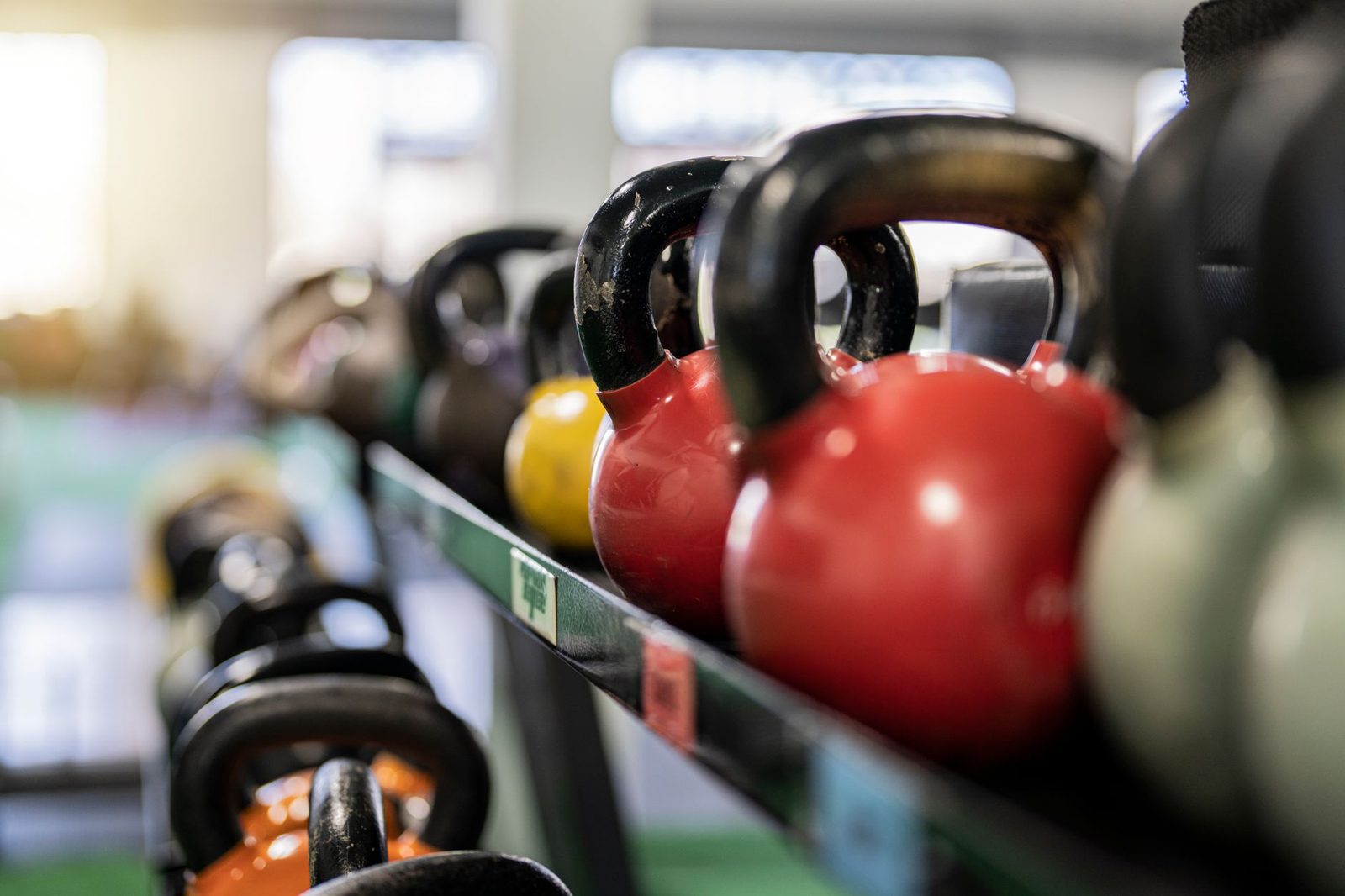
Quick answer: dumbbells are the better all-round tool for steady strength work such as presses, rows and curls, and they make small, gradual progression easy. Kettlebells shine for swinging and ballistic movements such as swings, cleans and snatches, which combine strength, power and conditioning. Research on kettlebells is promising but limited. Many home lifters get the best of both by owning a few dumbbells and one or two kettlebells.
How the designs differ
A dumbbell has its weight split evenly on either side of a short handle, so the load sits in line with your hand. A kettlebell has a single cast ball with a handle on top, so most of its weight sits below and slightly away from your grip. That offset is the heart of the difference.
- Dumbbells feel stable and balanced. They are natural for pressing, rowing, curling and lunging, where you want the load to move in a controlled line.
- Kettlebells can be swung between the legs and around the body, and they sit on the back of the forearm in the rack position. That makes them well suited to hip-driven, momentum-based movements.
A brief history
A 2019 scoping review by Meigh and colleagues notes that kettlebells were used as measures of weight in Russia in the 1700s, and that kettlebell sport, also called Girevoy sport, originated in Eastern Europe in 1948. Kettlebells are now made in weights from 2 kg to 92 kg.
What the research says
Dumbbells fall under the large body of free weight research. A 2023 meta-analysis by Haugen and colleagues found that free weight training builds muscle as effectively as machines, with strength gains specific to the equipment used. ACSM’s 2026 guidance adds that the type of equipment does not consistently change outcomes for healthy adults.
Kettlebell evidence is smaller:
- Strength and power: Lake and Lauder (2012) found that six weeks of twice-weekly kettlebell swing training improved half squat strength by 9.8% and vertical jump by 19.8% in young men, similar to jump squat training.
- Compared with weightlifting: Otto and colleagues (2012) found both kettlebell training and weightlifting with heavy resistance training improved strength and power over six weeks, but strength gains were greater with weightlifting.
- Conditioning: Farrar and colleagues (2010) found that 12 minutes of continuous two-handed swings with a 16 kg kettlebell pushed heart rate to about 87% of maximum in college-aged men, a level they judged sufficient to challenge aerobic fitness.
- Overall quality: Meigh and colleagues’ 2019 scoping review of 99 publications concluded that effect sizes were typically trivial to small and confidence in reported effects was low to very low, because most longitudinal studies were small and of low methodological quality.
In short, both tools work. Dumbbells have the deeper evidence base for general strength and muscle, while kettlebells have encouraging but thinner evidence for power and conditioning.
Side by side
| Factor | Dumbbell | Kettlebell |
|---|---|---|
| Weight position | Balanced either side of the hand | Mostly below and away from the handle |
| Best for | Presses, rows, curls, lunges, isolation work | Swings, cleans, snatches, goblet squats, carries |
| Learning curve | Gentle for most exercises | Steeper for ballistic lifts; coaching helps |
| Weight steps | Often small, especially with adjustable sets | Usually larger jumps between bells |
| Conditioning potential | Moderate, through circuits | High, through continuous swings |
| Floor space | A rack or an adjustable pair | A single bell can go a long way |
| Evidence base | Large, as part of free weight research | Growing but limited and mostly small studies |
When to choose dumbbells
- You want to build general strength and muscle across every major muscle group.
- You want small, steady increases in load.
- You prefer controlled, slower movements, or you are new to training.
- You want lots of upper body isolation work, such as lateral raises and curls.
When to choose kettlebells
- You want efficient sessions that combine strength and conditioning.
- You enjoy learning skills such as the swing, clean and snatch.
- You have very little space; one or two bells can support a full routine.
- You want to train the hip hinge powerfully. McGill and Marshall (2012) found that swings with a 16 kg bell produced high gluteal and back extensor activation in a hip-hinge pattern.
Using both together
You do not have to pick one. A simple approach is to use kettlebells for swings and goblet squats at the start of a session, when you are fresh, and dumbbells for presses, rows and arm work afterwards. ACSM’s 2009 guidance recommends doing more demanding, multi-joint exercises before smaller, single-joint ones, which fits this order well. Keep covering all major muscle groups on at least two days a week, as the NHS advises.
Safety notes
Ballistic kettlebell lifts need a clear space in front and behind you, and a secure grip; dry hands and a clean handle help. McGill and Marshall observed that while many people credit swings with helping their back, a few find they irritate tissues, so build up gradually and stop if something hurts. With either tool, learn the movement with a light weight before adding load.
Health note: this article is general education, not medical advice. If you have a health condition, an injury, are pregnant, or have not exercised for a long time, check with your GP or a physiotherapist before starting or changing a training plan, and stop if an exercise causes pain.
Sources
- Meigh et al. (2019) Kettlebell training in clinical practice: a scoping review, BMC Sports Science, Medicine and Rehabilitation (europepmc.org)
- Haugen et al. (2023) Effect of free-weight vs. machine-based strength training on maximal strength, hypertrophy and jump performance: a systematic review and meta-analysis, BMC Sports Science, Medicine and Rehabilitation (pmc.ncbi.nlm.nih.gov)
- ACSM unveils landmark 2026 resistance training guidelines, American College of Sports Medicine (acsm.org)
- Lake and Lauder (2012) Kettlebell swing training improves maximal and explosive strength, Journal of Strength and Conditioning Research (europepmc.org)
- Otto et al. (2012) Effects of weightlifting vs. kettlebell training on vertical jump, strength, and body composition, Journal of Strength and Conditioning Research (europepmc.org)
- Farrar, Mayhew and Koch (2010) Oxygen cost of kettlebell swings, Journal of Strength and Conditioning Research (europepmc.org)
- McGill and Marshall (2012) Kettlebell swing, snatch, and bottoms-up carry: back and hip muscle activation, motion, and low back loads, Journal of Strength and Conditioning Research (europepmc.org)
- ACSM position stand: Progression models in resistance training for healthy adults (2009), Medicine and Science in Sports and Exercise (europepmc.org)
- Physical activity guidelines for adults aged 19 to 64, NHS (nhs.uk)
Leave a Reply