
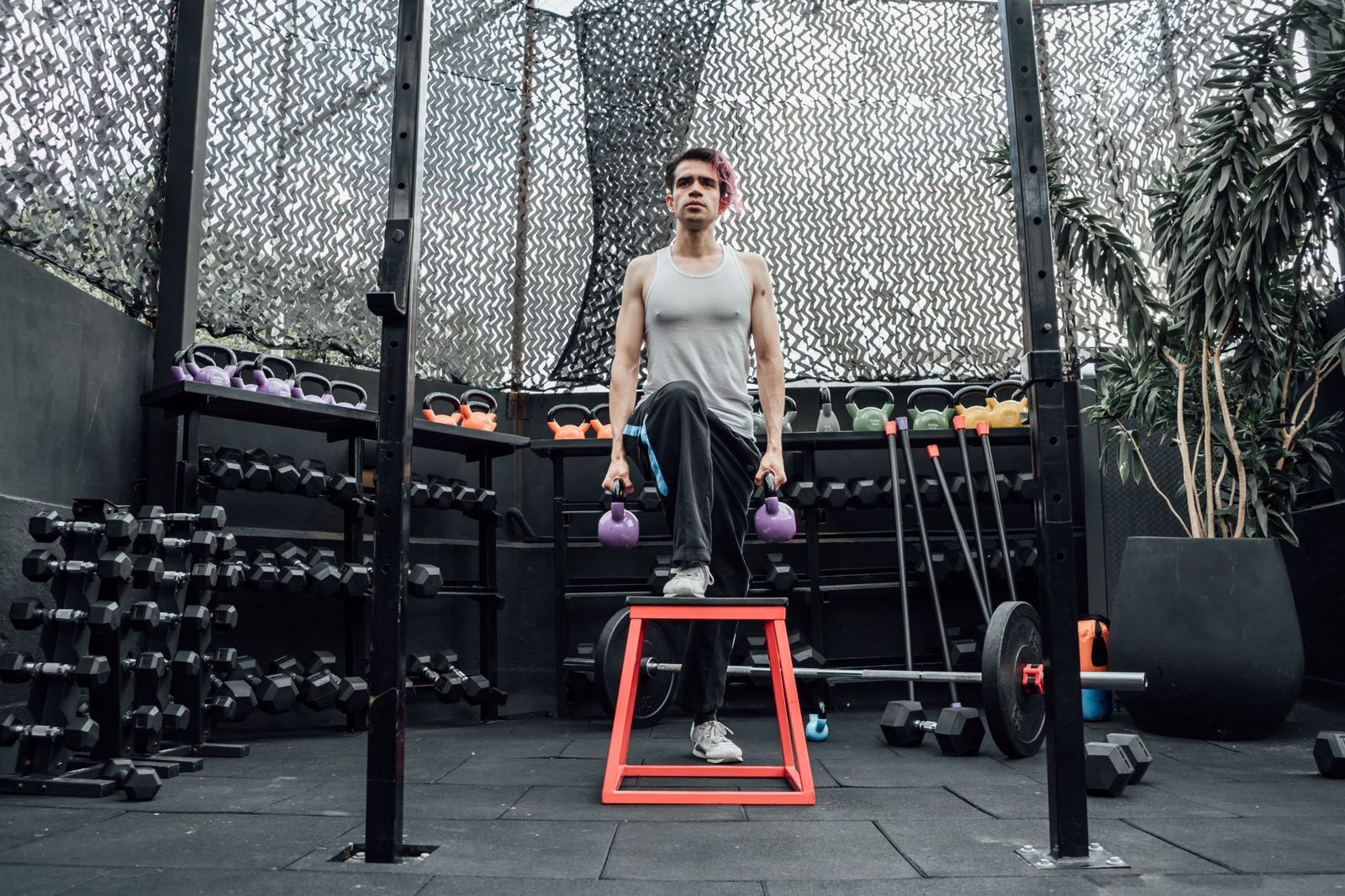
Quick answer: do this full-body kettlebell workout two or three times a week on non-consecutive days. It uses the deadlift, goblet squat, swing, row, press and carry to cover the major muscle groups the NHS recommends training at least twice a week. Start with light to moderate bells, do 2 to 3 sets of 8 to 12 reps, and progress by adding reps, then sets, then weight.
What you need
- One or two kettlebells: a lighter one for pressing and rows, a heavier one for deadlifts, squats and swings.
- A clear space with room in front and behind for swings.
- A flat, non-slip floor or mat.
- About 30 to 40 minutes.
Is kettlebell training suitable for beginners?
With sensible progression, yes. In the BELL trial by Meigh and colleagues (2022), previously insufficiently active adults aged 59 to 79 took part in three months of supervised, progressive hardstyle kettlebell training. Compliance was 91.5%, there were four non-serious adverse events, and participants improved grip strength, six-minute walk distance, deadlift strength and sit-to-stand performance. In working adults, Jay and colleagues (2011) found that eight weeks of kettlebell training, three times a week, reduced neck, shoulder and lower back pain and improved back strength, although it did not improve aerobic fitness.
The overall evidence is still limited. A 2019 scoping review found that most kettlebell studies were small and of low quality, so kettlebells are best seen as one useful tool within a balanced routine.
Warm-up (5 minutes)
- March on the spot or walk briskly for 2 minutes.
- Arm circles and shoulder rolls, 10 each way.
- Bodyweight hip hinges, 10 reps, pushing the hips back.
- Bodyweight squats, 10 reps.
- One light set of kettlebell deadlifts, 8 reps.
The workout
| Order | Exercise | Sets x reps | Rest | Bell |
|---|---|---|---|---|
| 1 | Kettlebell deadlift | 3 x 8 to 12 | 60 to 90 seconds | Heavier |
| 2 | Goblet squat | 3 x 8 to 12 | 60 to 90 seconds | Heavier or lighter |
| 3 | Two-handed swing | 5 x 10 | Until breathing settles | Heavier |
| 4 | Single-arm row | 2 to 3 x 8 to 12 each side | 60 seconds | Heavier or lighter |
| 5 | Single-arm overhead press | 2 to 3 x 6 to 10 each side | 60 seconds | Lighter |
| 6 | Suitcase carry | 2 x 20 to 30 metres each hand | 60 seconds | Heavier |
This order follows ACSM’s 2009 advice to place larger, multi-joint exercises before smaller ones. If you are completely new to kettlebells, replace swings with extra deadlifts for the first two weeks while you learn the hinge.
Exercise guide
Kettlebell deadlift
Stand with the bell between your feet. Push your hips back, keep your back neutral, grip the handle and stand tall. Keep the bell close to you, as the Health and Safety Executive’s handling guidance advises for any load.
Goblet squat
Hold the bell by the horns at chest height. Squat down between your knees as far as is comfortable with your chest up, then stand.
Two-handed swing
Hike the bell back between your thighs, then snap your hips forward so it floats to chest height. Your arms stay relaxed; the power comes from your hips. McGill and Marshall (2012) described the swing as a hip-hinge pattern with high glute and back muscle activation.
Single-arm row
Brace one hand on a bench or sturdy chair, hold the bell in the other, and pull it towards your hip. Lower slowly.
Single-arm overhead press
Clean or lift the bell to the rack position, where it rests on the back of your forearm at shoulder height. Brace and press it overhead without leaning back.
Suitcase carry
Hold a heavy bell in one hand and walk tall without leaning to the side. Switch hands.
Eight-week plan
| Weeks | Sessions per week | Focus | Progression |
|---|---|---|---|
| 1 to 2 | 2 | Technique: hinge, squat, press; swings only once the deadlift is solid | 2 sets, light bells |
| 3 to 4 | 2 | Working sets with 2 to 3 reps in reserve | 3 sets; add reps each session |
| 5 to 6 | 2 to 3 | Build swing volume | Increase swings to 6 to 8 sets of 10 |
| 7 to 8 | 2 to 3 | Move up a bell where reps are easy | Heavier bell for deadlifts, squats or swings |
ACSM’s 2009 guidance recommends two to three sessions a week for novices and a 2 to 10% load increase once you can do one or two reps above your target. Because kettlebells often jump in bigger steps, adding reps and sets first is a practical approach. ACSM’s 2026 guidance adds that finishing sets with two or three reps in reserve gives similar results to training to failure, with less fatigue.
Pair it with aerobic activity
The NHS recommends adults aim for 150 minutes of moderate aerobic activity a week, in addition to strength work on at least two days. Swings raise your heart rate, and Farrar and colleagues (2010) found continuous swings pushed heart rate to about 87% of maximum. However, Jay and colleagues’ trial did not find an improvement in aerobic fitness, so keep walking, cycling or other aerobic activity in your week too.
Safety reminders
- Keep children and pets out of the room during swings.
- Stop any exercise that causes pain, particularly in your back or shoulders.
- Put the bell down under control at the end of every set.
- If possible, have a qualified coach check your swing and press technique.
Health note: this article is general education, not medical advice. If you have a health condition, an injury, are pregnant, or have not exercised for a long time, check with your GP or a physiotherapist before starting or changing a training plan, and stop if an exercise causes pain.
Sources
- Meigh et al. (2022) Effects of supervised high-intensity hardstyle kettlebell training on grip strength and health-related physical fitness in insufficiently active older adults: the BELL trial, BMC Geriatrics (europepmc.org)
- Jay et al. (2011) Kettlebell training for musculoskeletal and cardiovascular health: a randomized controlled trial, Scandinavian Journal of Work, Environment and Health (europepmc.org)
- Meigh et al. (2019) Kettlebell training in clinical practice: a scoping review, BMC Sports Science, Medicine and Rehabilitation (europepmc.org)
- ACSM position stand: Progression models in resistance training for healthy adults (2009), Medicine and Science in Sports and Exercise (europepmc.org)
- ACSM unveils landmark 2026 resistance training guidelines, American College of Sports Medicine (acsm.org)
- Good handling technique, Health and Safety Executive (hse.gov.uk)
- McGill and Marshall (2012) Kettlebell swing, snatch, and bottoms-up carry: back and hip muscle activation, motion, and low back loads, Journal of Strength and Conditioning Research (europepmc.org)
- Farrar, Mayhew and Koch (2010) Oxygen cost of kettlebell swings, Journal of Strength and Conditioning Research (europepmc.org)
- Physical activity guidelines for adults aged 19 to 64, NHS (nhs.uk)
Leave a Reply