
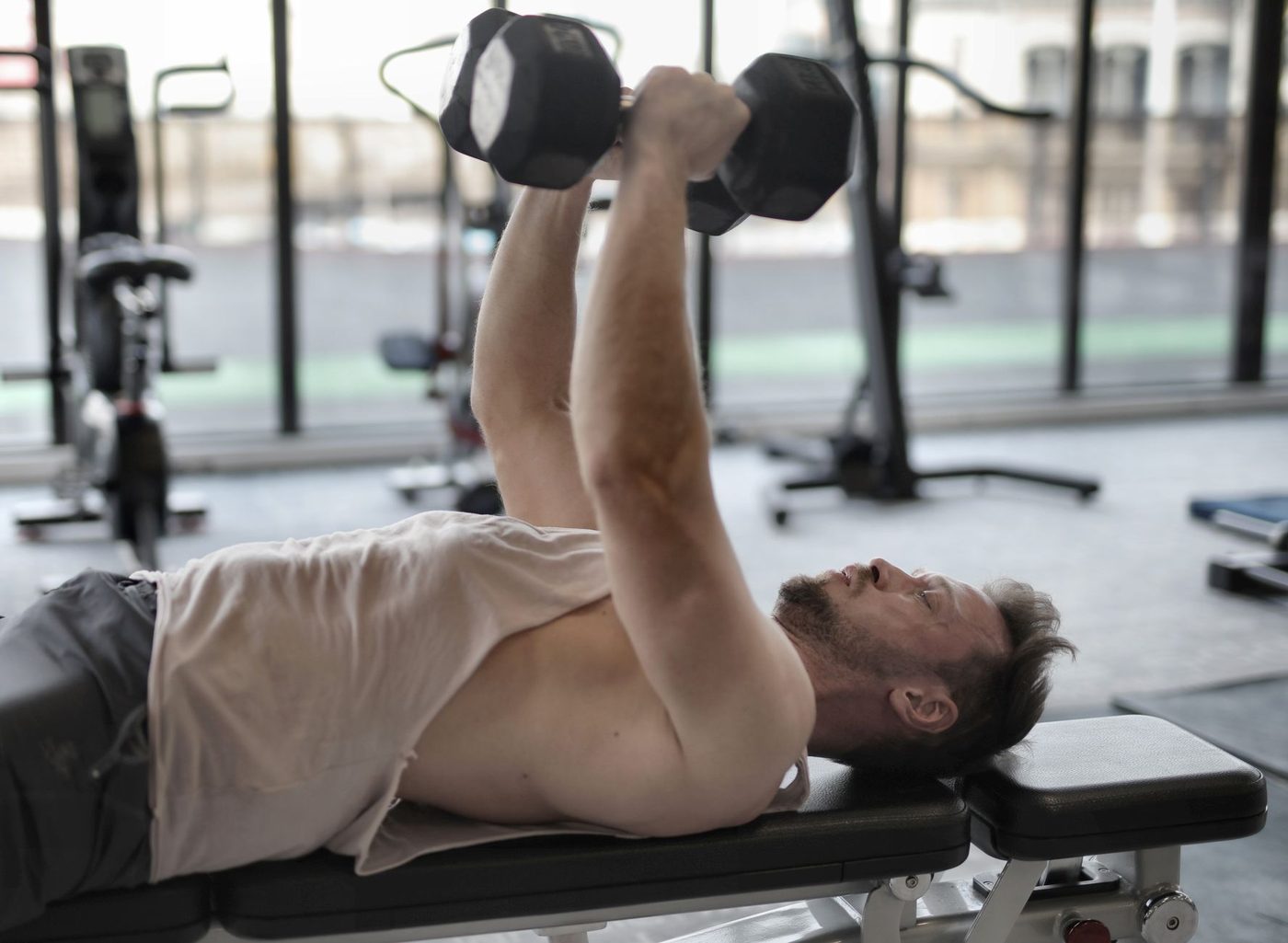
Dumbbell bench press or barbell bench press is a common choice when setting up home training. Laboratory studies have compared the two directly, usually with a Smith machine as a third option. The four studies below are small, mostly of trained men, and were read as published PubMed abstracts on 28 October 2026. They report what happened in the lab, not which exercise is better for any individual.
The four studies in one table
| Study | Who took part | What was compared | Stated result |
|---|---|---|---|
| Tillaar and Sæterbakken, 2012 | 11 men with at least a year of bench press training | One-repetition maximum (1RM) in barbell, Smith machine and dumbbell presses | 1RM was highest with the barbell, then the Smith machine, then dumbbells |
| Farias and colleagues, 2017 | 19 trained men | Four sets to a 10-repetition maximum with each press, 2 minutes rest | More total repetitions with dumbbells; different muscle activity patterns |
| Christian and colleagues, 2023 | 20 people (10 men, 10 women) with at least a year of training | Dumbbell and barbell presses at incline, flat and decline angles | Muscle activity differed by angle and by muscle |
| Sæterbakken and colleagues, 2020 | 35 resistance-trained men | Ten weeks of training with Smith machine, dumbbells or a barbell on a Swiss ball | Changes carried over to the barbell bench press |
The load: what the 1RM figures show
In the 2012 study, every participant was tested for a 1RM in all three chest-press exercises. The group reached 106.4 kg (standard deviation 15.5) with the free barbell, 103.6 kg (14.8) with the Smith machine and 89.5 kg (13.7) with dumbbells, as reported in the abstract, which does not say how the dumbbell figure was counted. Muscle activity, measured with electromyography (EMG), also differed between the exercises. The authors had expected that more freedom of movement would lengthen the “sticking region”, the weakest part of the lift, but the differences did not follow that order. They concluded that it is possible to choose a chest-press exercise to train a particular muscle more than the others.
More repetitions, different muscles busy
The 2017 study had 19 trained men perform each press for four sets with a 10-repetition-maximum load, resting 2 minutes between sets, and then do a triceps extension. Total repetitions were significantly higher with dumbbells (31.2) than with the barbell (27.8). The dumbbell press produced significantly greater pectoralis major activity than the barbell press, while the Smith machine produced greater anterior deltoid activity than either. The Smith machine and barbell presses produced greater triceps brachii activity than dumbbells, and dumbbells produced greater biceps brachii activity than the Smith machine and barbell. The authors reported that the choice of press also changed repetition performance and muscle activity in the triceps extension that followed.
Does the angle change the answer?
The 2023 study asked 20 people, aged 24 on average, to find a 1RM for flat dumbbell and barbell bench presses, then lift at 70% of that 1RM at incline, flat and decline positions. Anterior deltoid activation was significantly higher during the incline barbell press than during the decline barbell and decline dumbbell presses. Pectoralis major activation was significantly lower during the incline dumbbell press than the decline dumbbell press. The authors suggested that stability demands and shoulder width may explain some differences, and that sensor placement could have affected the pectoralis readings during the decline press. They also inferred that larger amounts of body fat in the female participants caused irregularities in the pectoralis data. Those explanations are the authors’ own, not tested findings.
After ten weeks of training
The 2020 trial randomised 35 resistance-trained men, averaging 4.2 years of training, to a ten-week programme with two chest-press sessions a week using a Smith machine, dumbbells, or a barbell on a Swiss ball. Everyone was tested on a 6-repetition maximum in both their own exercise and the barbell bench press. All three groups lifted more slowly and spent longer in the sticking and post-sticking regions at the end, and regardless of which exercise was trained, no differences were observed in vertical displacement or in muscle activity across the lifting regions. The authors read this as transfer to the untrained barbell press, and noted that improved strength altered the sticking region in resistance-trained men.
What these abstracts do not say
- None reports muscle size, so none shows which press builds more muscle.
- Samples are small, and three of the four include only men.
- Participants were trained lifters; beginners were not the focus.
- EMG records electrical activity during a lift, which is different from long-term results.
- The abstracts give no safety comparison between the exercises.
The bottom line
Across these four small studies, barbell presses allowed higher 1RM loads, dumbbells allowed more repetitions in one set of tests, and the muscles with the highest activity varied by exercise and angle. The authors of the 2012 study suggested choosing a press to emphasise a muscle, and the 2020 trial found carry-over from the trained exercise to the barbell press. Anyone changing their training should follow qualified coaching advice.
Sources
- The sticking region in three chest-press exercises with increasing degrees of freedom, Journal of Strength and Conditioning Research, 2012 (abstract on PubMed), read 28 October 2026 (pubmed.ncbi.nlm.nih.gov)
- Maximal strength performance and muscle activation for the bench press and triceps extension exercises adopting dumbbell, barbell, and machine modalities over multiple sets, Journal of Strength and Conditioning Research, 2017 (abstract on PubMed), read 28 October 2026 (pubmed.ncbi.nlm.nih.gov)
- Analysis of the activation of upper-extremity muscles during various chest press modalities, Journal of Strength and Conditioning Research, 2023 (abstract on PubMed), read 28 October 2026 (pubmed.ncbi.nlm.nih.gov)
- The effects of ten weeks resistance training on sticking region in chest-press exercises, PLoS One, 2020 (abstract on PubMed), read 28 October 2026 (pubmed.ncbi.nlm.nih.gov)
Leave a Reply