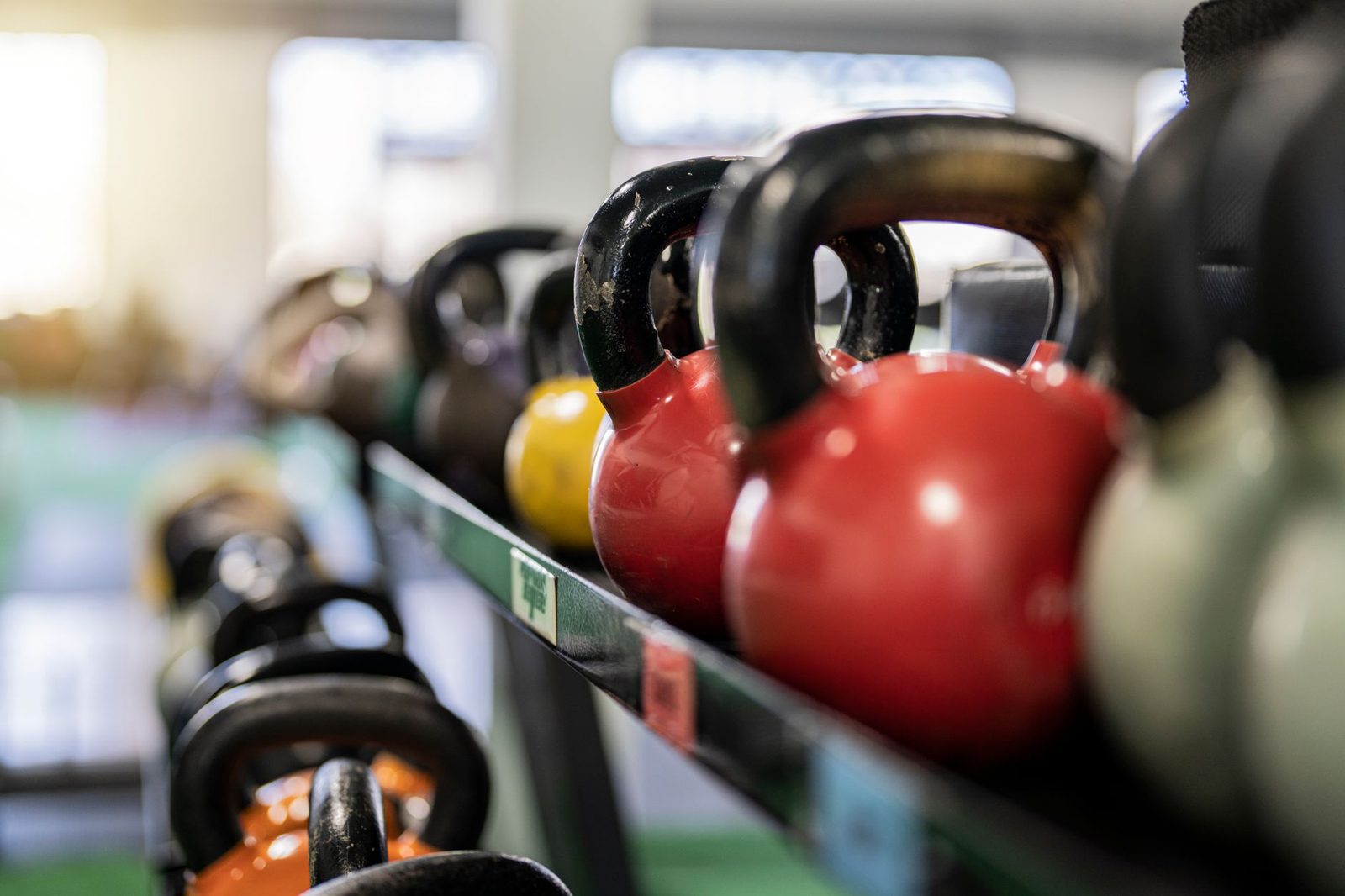
Author: Warrior Weights

  • What Weight Kettlebell Should I Use? A Guide for Beginners

    What Weight Kettlebell Should I Use? A Guide for Beginners

    Quick answer: there is no official kettlebell weight chart for men, women or beginners, so choose by exercise and by testing. You will need a heavier bell for two-handed swings and deadlifts than for presses and single-arm work. In research, young men have commonly swung 12 to 16 kg bells, and older adults in one trial started with 8 kg at home. Pick a bell you can move for 8 to 12 clean reps with two or three in reserve, and adjust from there.

    Why there is no single answer

    Kettlebell weight charts on the internet usually split recommendations by sex and experience, but they are rules of thumb rather than evidence. A 2019 scoping review by Meigh and colleagues noted that there are no authoritative guidelines for prescribing kettlebells in primary care, and that research uses a wide range of approaches. Your starting weight depends on your strength, your training history, the exercise, and your technique, not just your sex.

    What we can do is look at what studies used, then apply the same rep-based method that guides all resistance training.

    Kettlebell weights used in research

    Study Participants Kettlebell weight Exercise
    Lake and Lauder (2012) Healthy men aged 18 to 27 12 kg if under 70 kg body mass; 16 kg if over 70 kg Two-handed swings, 30 seconds on, 30 seconds off
    Farrar and colleagues (2010) College-aged men 16 kg Continuous swings for 12 minutes
    McGill and Marshall (2012) Male participants 16 kg Swings, snatches and carries
    BELL trial, Meigh and colleagues (2022) Men and women aged 59 to 79 8 kg for home training at the start; bells from 8 to 40 kg allocated by capacity later Hardstyle kettlebell programme

    Most studies have been done with men, so there is little direct research to guide starting weights for women. The BELL trial is useful here: it included 16 women and 16 men who were previously insufficiently active, and training was individualised, with stronger participants given heavier kettlebells.

    Choose by exercise

    Different kettlebell movements use very different muscles, so one bell rarely suits everything.

    Exercise Main muscles Relative weight
    Deadlift Hips, thighs, back Heaviest
    Two-handed swing Glutes, hamstrings, back Heavy
    Goblet squat Thighs, glutes Moderate to heavy
    Single-arm row Upper back Moderate
    Single-arm swing or clean Hips, grip, shoulders Moderate
    Overhead press Shoulders, triceps Light to moderate
    Turkish get-up Whole body, shoulder stability Lightest; start with no weight

    This is why many people eventually own two bells: a lighter one for presses and get-ups, and a heavier one for swings, deadlifts and squats.

    The starting weight test

    The NHS recommends 8 to 12 reps per set for strengthening exercises, and ACSM’s 2009 guidance recommends that novices use loads that allow 8 to 12 repetitions. ACSM’s 2026 guidance adds that finishing sets with about two or three reps in reserve gives similar results to going to failure, with less fatigue.

    1. Deadlift first. Learn the hip hinge by deadlifting the bell from between your feet. If you can do 10 smooth reps with a neutral back and clearly have more in reserve, it is likely a reasonable swing weight too.
    2. Test the goblet squat. Hold the bell at your chest and do 8 to 12 reps. If your chest collapses forward or you cannot hold the bell comfortably, go lighter.
    3. Test the press separately. Press the bell overhead with one arm. If you cannot do at least 5 controlled reps without leaning back, this bell is too heavy for pressing.
    4. Be honest about swings. A bell that is too light for swings is less of a problem than one that is too heavy, because good technique matters more than load when you are learning.

    How the size of the jump affects progress

    Kettlebells usually go up in larger steps than dumbbells. Meigh and colleagues note that competition kettlebells are commonly available from 8 kg to 32 kg in 2 to 4 kg increments. A 4 kg jump is a big percentage increase at lighter weights. ACSM’s 2009 guidance recommends increasing load by 2 to 10% when you can beat your target by one or two reps, so with kettlebells you will often progress by adding reps, sets or harder variations first, then moving up a bell.

    That approach is supported by a 2022 study by Plotkin and colleagues, which found that adding reps at a fixed load produced broadly similar results to adding load over eight weeks.

    Signs your kettlebell is too heavy

    • Your back rounds as you pick it up or at the bottom of a swing.
    • You lift the bell with your arms rather than drive it with your hips in a swing.
    • The bell drifts away from your body and pulls you forward.
    • You lean back to press it overhead.
    • You feel it in your lower back or joints rather than in your hips and legs.

    Signs it is too light

    • You can do 20 or more perfect swings and feel nothing in your glutes and hamstrings.
    • Goblet squats feel easy for 15 reps or more.
    • Your heart rate barely rises during a set of swings.

    A note on older and returning lifters

    The BELL trial found that a supervised, progressive hardstyle kettlebell programme was well tolerated by previously inactive adults aged 59 to 79, with very high compliance of 91.5% and four non-serious adverse events. It improved grip strength, walking distance and several measures of strength. Participants were supervised and could choose their own weights, which is a good model: start light, get coaching if you can, and build up gradually. The NHS advises speaking to a GP first if you have not exercised for some time or have medical conditions.

    Health note: this article is general education, not medical advice. If you have a health condition, an injury, are pregnant, or have not exercised for a long time, check with your GP or a physiotherapist before starting or changing a training plan, and stop if an exercise causes pain.

    Sources

    • Meigh et al. (2019) Kettlebell training in clinical practice: a scoping review, BMC Sports Science, Medicine and Rehabilitation (europepmc.org)
    • Lake and Lauder (2012) Kettlebell swing training improves maximal and explosive strength, Journal of Strength and Conditioning Research (europepmc.org)
    • Farrar, Mayhew and Koch (2010) Oxygen cost of kettlebell swings, Journal of Strength and Conditioning Research (europepmc.org)
    • McGill and Marshall (2012) Kettlebell swing, snatch, and bottoms-up carry: back and hip muscle activation, motion, and low back loads, Journal of Strength and Conditioning Research (europepmc.org)
    • Meigh et al. (2022) Effects of supervised high-intensity hardstyle kettlebell training on grip strength and health-related physical fitness in insufficiently active older adults: the BELL trial, BMC Geriatrics (europepmc.org)
    • How to improve your strength and flexibility, NHS (nhs.uk)
    • ACSM position stand: Progression models in resistance training for healthy adults (2009), Medicine and Science in Sports and Exercise (europepmc.org)
    • ACSM unveils landmark 2026 resistance training guidelines, American College of Sports Medicine (acsm.org)
    • Plotkin et al. (2022) Progressive overload without progressing load? The effects of load or repetition progression on muscular adaptations, PeerJ (europepmc.org)
    • Physical activity guidelines for older adults, NHS (nhs.uk)
  • Types of Dumbbells Explained: Hex, Rubber, Chrome and Adjustable

    Types of Dumbbells Explained: Hex, Rubber, Chrome and Adjustable

    Quick answer: dumbbells come in two broad families. Fixed dumbbells, such as rubber hex, chrome, cast iron and neoprene coated, are one weight each and are quick to grab. Adjustable dumbbells, either plate-loaded spin-lock handles or selectorised designs with a dial or pin, give many weights in a small footprint. The right type depends on how heavy you need to go, your space, your floor and how quickly you like to change weight.

    Why the type of dumbbell matters

    All dumbbells do the same basic job: they let you load one hand at a time, so you can train each side independently and move through a natural path. But the shape, coating and adjustment system affect comfort, safety, noise, floor protection and how easily you can progress. Since the NHS recommends working all major muscle groups on at least two days a week, and your legs and back will usually need heavier loads than your arms, it pays to choose a type that can grow with you.

    Fixed dumbbells

    Rubber hex dumbbells

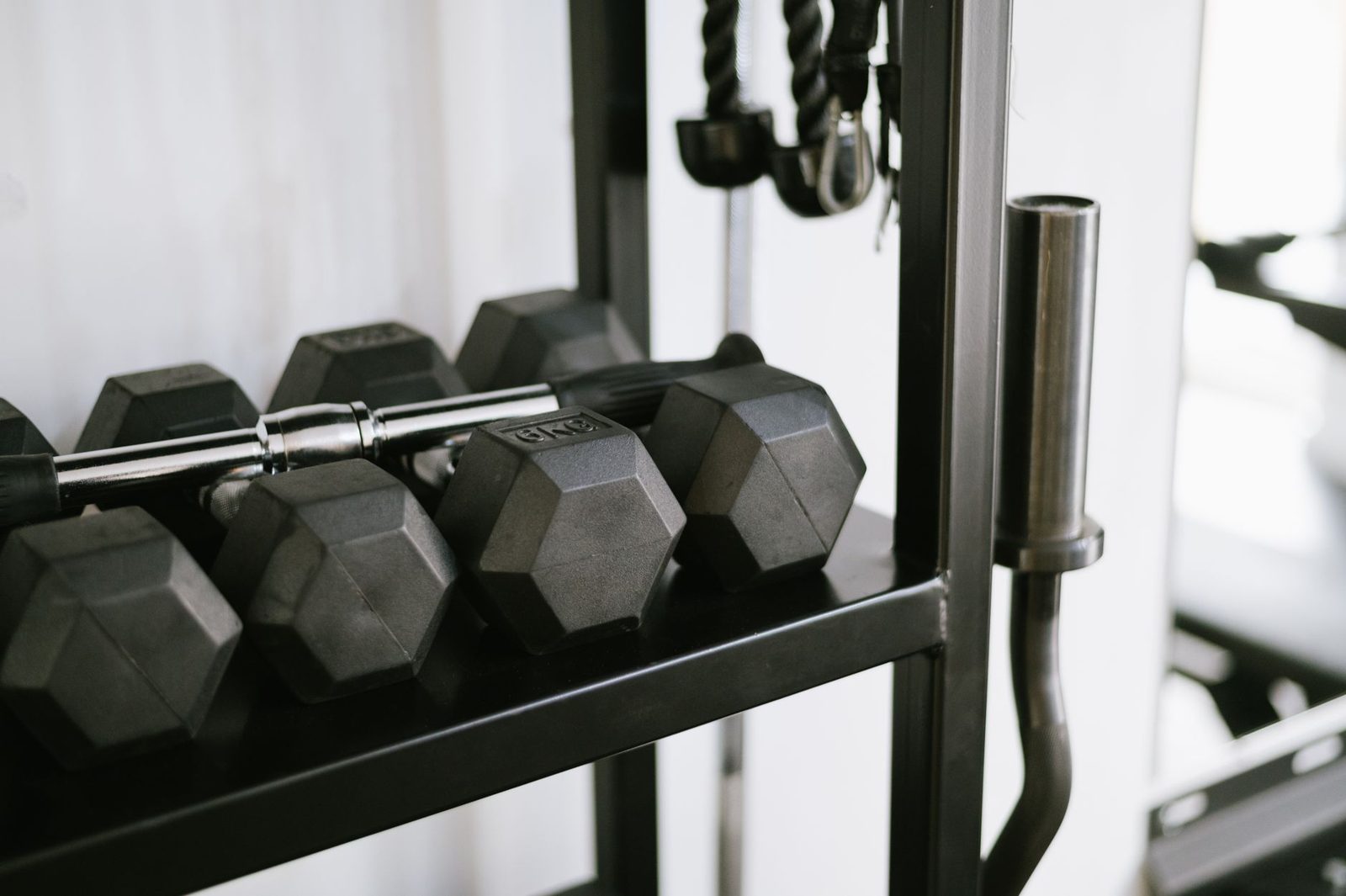
    These have hexagonal heads coated in rubber, usually with a knurled steel or chrome handle. The flat sides stop them rolling away when you put them down, which is useful for exercises such as renegade rows or when you rest them on the floor between sets. The rubber coating reduces noise and protects floors.

    Round rubber or urethane dumbbells

    Round heads are common in commercial gyms and are coated in rubber or urethane, an alternative coating material. They feel comfortable in the hand, but round heads can roll, so store them on a rack.

    Chrome dumbbells

    Chrome dumbbells are all metal with a polished finish. They are compact for their weight and easy to wipe clean, which makes them popular for lighter weights. Because they are bare metal, they are noisier and less kind to floors if put down carelessly.

    Cast iron dumbbells

    Plain or painted cast iron is simple and durable. It is prone to surface rust if kept somewhere damp, and it can chip paint or flooring on impact.

    Neoprene or vinyl coated dumbbells

    These light dumbbells have a soft coating that is comfortable to hold and comes in bright colours for each weight. They suit mobility work, rehabilitation exercises prescribed by a professional, and the gentle strength routines the NHS suggests, such as biceps curls with light weights. They are rarely made in heavier sizes.

    Adjustable dumbbells

    Plate-loaded spin-lock handles

    A bar with threaded ends takes small weight plates, which are held in place by screw-on collars. They are simple and cheap to expand, but changing weight takes time, and the collars must be checked every session because they can loosen. Plates need to match the handle’s sleeve diameter.

    Selectorised dumbbells

    These use a dial, pin or slide mechanism to pick up a chosen number of plates from a cradle. Weight changes take seconds and one pair can replace a whole rack. The trade-offs are a bulkier shape at lighter weights, a mechanism that must be treated carefully, and fixed weight increments set by the design.

    Comparison table

    Type Main strengths Watch out for Good for
    Rubber hex Does not roll, quieter, floor friendly Rubber smell when new; takes space as a set General home training
    Round rubber or urethane Durable, comfortable, gym feel Rolls if not racked Racked collections
    Chrome Compact, easy to clean Noisy, hard on floors Lighter weights, isolation work
    Cast iron Simple, hard wearing Rust and chipping Dry garages and sheds
    Neoprene or vinyl Soft grip, colour coded Light weights only Gentle strength and mobility work
    Spin-lock adjustable Expandable, compact Slow changes; collars can loosen Tight budgets and small spaces
    Selectorised adjustable Very fast weight changes, one pair Bulky shape; mechanism care; fixed steps Small spaces, circuits

    Handles and grip

    Look at the handle as closely as the head. Knurling, the cross-hatched texture on metal handles, improves grip when your hands are sweaty. A handle that is too thick can limit how long you can hold heavier weights, while a very smooth handle can slip. Contoured handles can be more comfortable for pressing but may feel odd for rows. If possible, hold a dumbbell before you commit to a whole set.

    Safety considerations

    An analysis of US emergency department data by Kerr and colleagues found that weights dropping on people were the most common cause of weight training injuries, and 90.4% of injuries involved free weights. A few habits reduce that risk:

    • Check that heads are firmly fixed and that adjustable collars or selectors are fully engaged before every set.
    • Store dumbbells on a rack or low shelf, not stacked or left on the floor.
    • Choose shapes that will not roll if you have children, pets or a sloping floor.
    • Keep children away from equipment; the same study found young children were more likely to suffer hand injuries.

    Looking after your dumbbells

    • Wipe them down after use to remove sweat, which speeds up rust and wear.
    • Keep them dry. Garages and sheds can be damp in a UK winter; a dehumidifier or sealed storage helps iron and chrome.
    • Air out new rubber in a ventilated space if it has a strong smell.
    • Inspect regularly for loose heads, cracked coatings, bent handles or worn threads.
    • Treat adjustable mechanisms gently and follow the maker’s instructions; do not drop selectorised dumbbells.

    How to choose

    If you train at home with limited space, an adjustable pair or a small set of fixed rubber hex dumbbells covers most needs. If several people train together, or you like to move quickly between exercises, a fixed set on a rack is convenient. Think about the heaviest weight you are likely to need for squats and rows in a year’s time, as well as the lightest you need for shoulder raises today.

    Health note: this article is general education, not medical advice. If you have a health condition, an injury, are pregnant, or have not exercised for a long time, check with your GP or a physiotherapist before starting or changing a training plan, and stop if an exercise causes pain.

    Sources

    • Physical activity guidelines for adults aged 19 to 64, NHS (nhs.uk)
    • Strength exercises, NHS (nhs.uk)
    • Kerr, Collins and Comstock (2010) Epidemiology of weight training-related injuries presenting to United States emergency departments, 1990 to 2007, American Journal of Sports Medicine (europepmc.org)
  • Progressive Overload Explained: How to Keep Getting Stronger

    Progressive Overload Explained: How to Keep Getting Stronger

    Quick answer: progressive overload means gradually increasing the demand on your muscles so they keep adapting. With free weights you can do this by adding load, adding repetitions, adding sets, or improving control and range of movement. ACSM guidance suggests increasing the load by 2 to 10% once you can complete one or two reps more than your target, and research shows adding reps at a fixed weight can work nearly as well as adding weight.

    What progressive overload means

    Your body adapts to the work you give it. If you lift the same weight for the same reps week after week, there is little reason for it to keep changing. The American College of Sports Medicine’s 2009 position stand on progression models states that progressive resistance training protocols are necessary to stimulate further adaptation towards specific goals.

    Overload does not mean lifting as heavy as possible. It means asking for a little more than last time, in a controlled way, over a long period.

    Five ways to progress with free weights

    Method Example Best used when
    Add load Goblet squat moves from 12 kg to 14 kg You beat your target reps by one or two on every set
    Add repetitions 3 sets of 8 becomes 3 sets of 10 with the same dumbbells The next weight up is a big jump, common with home equipment
    Add sets 2 sets of an exercise becomes 3 You want more weekly volume for a muscle group
    Improve range and control Slower lowering, deeper comfortable squat, pause at the bottom Technique is still developing
    Harder variation Two-arm row becomes one-arm row; goblet squat becomes split squat You have run out of weight on your equipment

    The double progression method

    For home lifters with a limited set of weights, double progression is a simple, reliable approach. You choose a rep range, for example 8 to 12, and a weight you can lift for 8 good reps.

    1. Each session, try to add a rep to one or more sets while keeping the same weight.
    2. When you can do 12 good reps on every set, move up to the next weight.
    3. Your reps will drop back towards 8. Build them up again, and repeat.

    This fits closely with ACSM’s 2009 guidance, which recommends a 2 to 10% increase in load when a person can perform the current workload for one to two repetitions over the desired number. It also fits the NHS suggestion of 8 to 12 repetitions per set.

    Is adding reps as good as adding weight?

    A 2022 study by Plotkin and colleagues, published in PeerJ, tested exactly this. Forty-three trained men and women either increased load while keeping reps constant, or increased reps while keeping load constant, for eight weeks. Muscle growth slightly favoured the reps group in one thigh muscle, and strength slightly favoured the load group, but the differences were of questionable practical significance. The authors concluded that both approaches appear to be viable.

    That is good news if your dumbbells go up in large steps. You can keep progressing by adding reps until the next weight becomes manageable.

    Heavier or lighter weights?

    A 2017 meta-analysis by Schoenfeld and colleagues compared low-load (60% of one-rep max or less) and high-load training, with sets taken to failure. Gains in maximal strength were greater with heavy loads, but muscle growth was similar across the loading spectrum. ACSM’s 2026 position stand points to around 80% of one-rep max for 2 to 3 sets when the goal is strength.

    So if you mainly want muscle and general fitness, a range of rep targets can work. If you want maximal strength, you will eventually need to lift heavier loads for fewer reps.

    More sets, more growth, up to a point

    Volume is another lever. A 2017 meta-analysis by Schoenfeld, Ogborn and Krieger found a graded dose-response relationship between weekly sets and muscle growth, meaning more weekly sets tended to produce more growth. ACSM’s 2026 guidance suggests roughly 10 sets per muscle group per week for hypertrophy. Beginners do not need to start there, and ACSM’s 2009 guidance also highlights that the right amount depends on training experience.

    How often to train

    A 2018 meta-analysis by Grgic and colleagues found that strength gains increased with training frequency overall, but when weekly volume was equal, frequency itself made no significant difference. In practice, training a muscle group two or three times a week is a convenient way to spread your sets, and it matches the NHS and UK Chief Medical Officers’ recommendation of at least two days a week.

    Signs you are progressing too fast

    • Your technique changes as the set goes on, such as a rounding back on a hinge or a rushed lowering phase.
    • You regularly miss reps you hit comfortably last week.
    • Joints, rather than muscles, feel sore after sessions.
    • Sleep, energy or motivation are dropping for a sustained period.

    If you notice these, hold or reduce the load for a week or two and rebuild. The UK Chief Medical Officers describe starting low and building up as your body adjusts as the safest approach, and that applies to every stage of training, not just the first week.

    Keep a training log

    You cannot progress what you do not measure. Record the exercise, weight, sets, reps and how hard it felt for each session. Over a few weeks the log will show you which lifts are moving and which have stalled, so you can decide whether to add a rep, add weight or change the variation.

    Putting it into practice

    Pick four to six free weight exercises that cover your legs, hips, back, chest, shoulders and arms. Use a rep range of 8 to 12, finish sets with two or three reps in reserve, and apply double progression. Review your log every few weeks. That simple system, repeated patiently, is progressive overload.

    Health note: this article is general education, not medical advice. If you have a health condition, an injury, are pregnant, or have not exercised for a long time, check with your GP or a physiotherapist before starting or changing a training plan, and stop if an exercise causes pain.

    Sources

    • ACSM position stand: Progression models in resistance training for healthy adults (2009), Medicine and Science in Sports and Exercise (europepmc.org)
    • ACSM unveils landmark 2026 resistance training guidelines, American College of Sports Medicine (acsm.org)
    • Plotkin et al. (2022) Progressive overload without progressing load? The effects of load or repetition progression on muscular adaptations, PeerJ (europepmc.org)
    • Schoenfeld et al. (2017) Strength and hypertrophy adaptations between low- vs. high-load resistance training: a systematic review and meta-analysis, Journal of Strength and Conditioning Research (europepmc.org)
    • Schoenfeld, Ogborn and Krieger (2017) Dose-response relationship between weekly resistance training volume and increases in muscle mass, Journal of Sports Sciences (europepmc.org)
    • Grgic et al. (2018) Effect of resistance training frequency on gains in muscular strength: a systematic review and meta-analysis, Sports Medicine (europepmc.org)
    • How to improve your strength and flexibility, NHS (nhs.uk)
    • UK Chief Medical Officers’ physical activity guidelines (2019), Department of Health and Social Care (gov.uk)
  • Olympic vs Standard Barbells and Weight Plates: A Beginner’s Guide

    Olympic vs Standard Barbells and Weight Plates: A Beginner’s Guide

    Quick answer: Olympic barbells have 50 mm sleeves and take plates with a matching large centre hole. International rules set the men’s bar at 20 kg and the women’s bar at 15 kg. Standard bars are thinner at the ends, typically take plates with holes of around 27 to 31 mm, and vary widely in length and weight. The two systems are not interchangeable, so match your plates to your bar and always use collars.

    Why this matters

    Barbells and plates are the backbone of free weight training, and plates also fit many plate-loaded dumbbell handles. Yet the terms Olympic and standard confuse many buyers. Get it wrong and your plates may not fit your bar, or may fit loosely, which is a safety issue. This guide explains the differences in plain terms.

    The Olympic barbell

    The International Weightlifting Federation (IWF) sets the rules for competition equipment. Its technical rules state that a men’s bar weighs 20 kg and a women’s bar weighs 15 kg, and that each barbell must be fitted with two collars weighing 2.5 kg each in competition.

    The same rules set out the dimensions. The men’s bar is 220 cm long with a 28 mm grip section, and the women’s bar is 201 cm long; other published specifications give its grip as 25 mm. On both bars the outer ends, called sleeves, where the plates go, are 50 mm in diameter, and the rules state that the sleeve must rotate freely.

    Outside competition, many training bars follow this Olympic pattern of 50 mm sleeves, even if their exact weight, length and grip vary. If a bar is described as Olympic, check the stated weight rather than assuming it is 20 kg.

    Standard barbells

    Standard bars, sometimes called one inch bars, are common in older home sets. The ends of standard bars usually do not rotate, and they commonly take plates with centre holes from around 27 mm to 31 mm. Their length ranges from roughly 1.2 metres to over 2 metres and their weight often falls somewhere between 4 kg and 10 kg. These dimensions are not governed by a single international standard in the way competition bars are, so they vary between makers.

    That variation is the main practical headache. Plates with smaller holes may not fit a slightly thicker standard bar, and plates with larger holes may sit loosely.

    Comparison table

    Feature Olympic system Standard system
    Sleeve diameter 50 mm Thinner, varies between makers
    Plate centre hole Sized for 50 mm sleeves Around 27 to 31 mm, varies
    Bar weight Competition bars: 20 kg men’s, 15 kg women’s Often around 4 to 10 kg
    Rotating sleeves Yes Usually no
    Rules body IWF for competition equipment No single standard
    Interchangeable with the other system? No No

    Weight plates explained

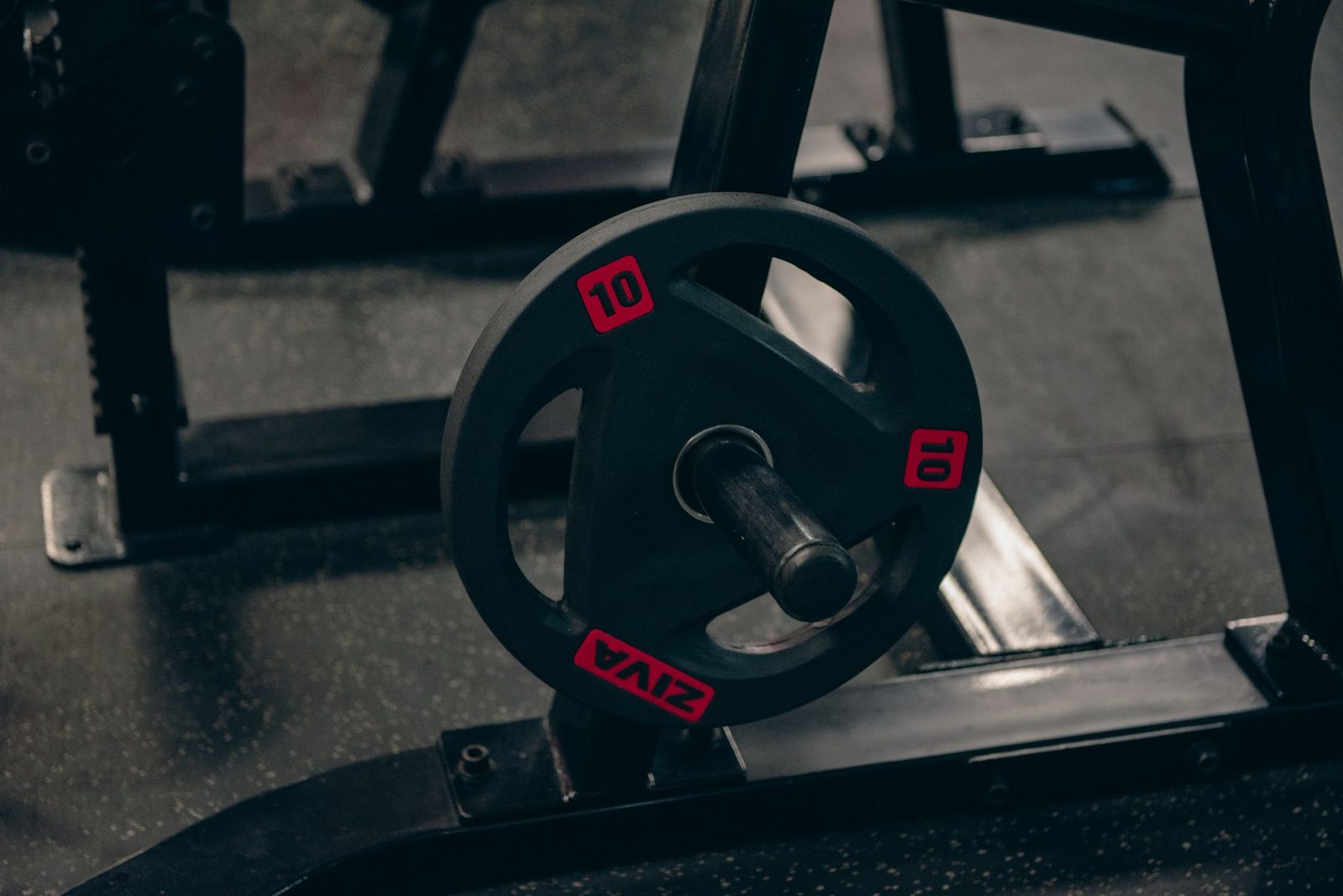
    IWF rules list competition discs from 25 kg down to 0.5 kg, each with a standard colour: 25 kg red, 20 kg blue, 15 kg yellow, 10 kg green and 5 kg white, with smaller change plates following the same colour sequence from 2.5 kg red down to 0.5 kg white. Competition discs of 10 kg and above have a diameter of 45 cm. Training discs may be made in black with coloured rims.

    At home you will mostly see three types of plate:

    • Cast iron plates: thin and hard wearing, but noisy and not designed to be dropped.
    • Rubber coated plates: iron plates with a rubber coating, quieter and kinder to floors.
    • Bumper plates: plates coated in solid rubber so they are safer to drop from overhead, as in weightlifting.

    Whatever type you use, check the actual weight marked on each plate and add the bar and collars to work out the total load you are lifting.

    Working out the total weight

    A simple formula avoids confusion: total load equals bar weight, plus collars, plus all the plates. For example, a 20 kg bar with two 10 kg plates and two light spring collars is a little over 40 kg. A lighter standard bar with the same plates would be much less. Write the bar weight down in your training log so your progress numbers stay consistent.

    Collars are not optional

    Collars stop plates sliding off the sleeve when the bar tilts. An analysis of US emergency department data by Kerr and colleagues found that the most common cause of weight training injuries was weights dropping on the person, at 65.5% of cases, and that 90.4% of injuries involved free weights. Secure, well-fitting collars and matched plates are a simple way to reduce that risk.

    Barbell safety at home

    • Load and unload plates evenly, one side then the other, so the bar does not tip.
    • Lift plates off the floor with good handling technique. The Health and Safety Executive advises keeping a load close to your waist, avoiding twisting your back, and not lifting more than you can easily manage.
    • Store plates on a proper holder rather than leaning them against walls where they can roll or fall.
    • Check sleeves and collars for wear, and never use a plate that fits loosely.
    • For heavy pressing or squatting, only lift where you can safely fail a rep, for example with safety supports. If you cannot set that up, choose dumbbell or kettlebell alternatives that you can drop to the side.

    Caring for bars and plates

    Keep iron equipment dry to limit rust, wipe sweat and chalk off the bar after sessions, and store it off the floor where possible. A light brush of the knurling, the textured grip area, keeps it clean. Rubber plates benefit from being kept out of direct sunlight and away from heat sources.

    Which system should you choose?

    If you are starting from scratch and plan to lift heavier over time, the Olympic system offers more consistency between bars and plates. If you already own a standard set, it can serve you well, provided every plate fits snugly and you use collars. The key rule is simple: do not mix systems, and always know exactly what your bar weighs.

    Health note: this article is general education, not medical advice. If you have a health condition, an injury, are pregnant, or have not exercised for a long time, check with your GP or a physiotherapist before starting or changing a training plan, and stop if an exercise causes pain.

    Sources

    • Technical and Competition Rules and Regulations, International Weightlifting Federation (2024 edition, mirror copy) (iwlf.in)
    • Barbell, Wikipedia (en.wikipedia.org)
    • Kerr, Collins and Comstock (2010) Epidemiology of weight training-related injuries presenting to United States emergency departments, 1990 to 2007, American Journal of Sports Medicine (europepmc.org)
    • Good handling technique, Health and Safety Executive (hse.gov.uk)
  • Kettlebell vs Dumbbell: Differences, Pros and Cons

    Kettlebell vs Dumbbell: Differences, Pros and Cons

    Quick answer: dumbbells are the better all-round tool for steady strength work such as presses, rows and curls, and they make small, gradual progression easy. Kettlebells shine for swinging and ballistic movements such as swings, cleans and snatches, which combine strength, power and conditioning. Research on kettlebells is promising but limited. Many home lifters get the best of both by owning a few dumbbells and one or two kettlebells.

    How the designs differ

    A dumbbell has its weight split evenly on either side of a short handle, so the load sits in line with your hand. A kettlebell has a single cast ball with a handle on top, so most of its weight sits below and slightly away from your grip. That offset is the heart of the difference.

    • Dumbbells feel stable and balanced. They are natural for pressing, rowing, curling and lunging, where you want the load to move in a controlled line.
    • Kettlebells can be swung between the legs and around the body, and they sit on the back of the forearm in the rack position. That makes them well suited to hip-driven, momentum-based movements.

    A brief history

    A 2019 scoping review by Meigh and colleagues notes that kettlebells were used as measures of weight in Russia in the 1700s, and that kettlebell sport, also called Girevoy sport, originated in Eastern Europe in 1948. Kettlebells are now made in weights from 2 kg to 92 kg.

    What the research says

    Dumbbells fall under the large body of free weight research. A 2023 meta-analysis by Haugen and colleagues found that free weight training builds muscle as effectively as machines, with strength gains specific to the equipment used. ACSM’s 2026 guidance adds that the type of equipment does not consistently change outcomes for healthy adults.

    Kettlebell evidence is smaller:

    • Strength and power: Lake and Lauder (2012) found that six weeks of twice-weekly kettlebell swing training improved half squat strength by 9.8% and vertical jump by 19.8% in young men, similar to jump squat training.
    • Compared with weightlifting: Otto and colleagues (2012) found both kettlebell training and weightlifting with heavy resistance training improved strength and power over six weeks, but strength gains were greater with weightlifting.
    • Conditioning: Farrar and colleagues (2010) found that 12 minutes of continuous two-handed swings with a 16 kg kettlebell pushed heart rate to about 87% of maximum in college-aged men, a level they judged sufficient to challenge aerobic fitness.
    • Overall quality: Meigh and colleagues’ 2019 scoping review of 99 publications concluded that effect sizes were typically trivial to small and confidence in reported effects was low to very low, because most longitudinal studies were small and of low methodological quality.

    In short, both tools work. Dumbbells have the deeper evidence base for general strength and muscle, while kettlebells have encouraging but thinner evidence for power and conditioning.

    Side by side

    Factor Dumbbell Kettlebell
    Weight position Balanced either side of the hand Mostly below and away from the handle
    Best for Presses, rows, curls, lunges, isolation work Swings, cleans, snatches, goblet squats, carries
    Learning curve Gentle for most exercises Steeper for ballistic lifts; coaching helps
    Weight steps Often small, especially with adjustable sets Usually larger jumps between bells
    Conditioning potential Moderate, through circuits High, through continuous swings
    Floor space A rack or an adjustable pair A single bell can go a long way
    Evidence base Large, as part of free weight research Growing but limited and mostly small studies

    When to choose dumbbells

    • You want to build general strength and muscle across every major muscle group.
    • You want small, steady increases in load.
    • You prefer controlled, slower movements, or you are new to training.
    • You want lots of upper body isolation work, such as lateral raises and curls.

    When to choose kettlebells

    • You want efficient sessions that combine strength and conditioning.
    • You enjoy learning skills such as the swing, clean and snatch.
    • You have very little space; one or two bells can support a full routine.
    • You want to train the hip hinge powerfully. McGill and Marshall (2012) found that swings with a 16 kg bell produced high gluteal and back extensor activation in a hip-hinge pattern.

    Using both together

    You do not have to pick one. A simple approach is to use kettlebells for swings and goblet squats at the start of a session, when you are fresh, and dumbbells for presses, rows and arm work afterwards. ACSM’s 2009 guidance recommends doing more demanding, multi-joint exercises before smaller, single-joint ones, which fits this order well. Keep covering all major muscle groups on at least two days a week, as the NHS advises.

    Safety notes

    Ballistic kettlebell lifts need a clear space in front and behind you, and a secure grip; dry hands and a clean handle help. McGill and Marshall observed that while many people credit swings with helping their back, a few find they irritate tissues, so build up gradually and stop if something hurts. With either tool, learn the movement with a light weight before adding load.

    Health note: this article is general education, not medical advice. If you have a health condition, an injury, are pregnant, or have not exercised for a long time, check with your GP or a physiotherapist before starting or changing a training plan, and stop if an exercise causes pain.

    Sources

    • Meigh et al. (2019) Kettlebell training in clinical practice: a scoping review, BMC Sports Science, Medicine and Rehabilitation (europepmc.org)
    • Haugen et al. (2023) Effect of free-weight vs. machine-based strength training on maximal strength, hypertrophy and jump performance: a systematic review and meta-analysis, BMC Sports Science, Medicine and Rehabilitation (pmc.ncbi.nlm.nih.gov)
    • ACSM unveils landmark 2026 resistance training guidelines, American College of Sports Medicine (acsm.org)
    • Lake and Lauder (2012) Kettlebell swing training improves maximal and explosive strength, Journal of Strength and Conditioning Research (europepmc.org)
    • Otto et al. (2012) Effects of weightlifting vs. kettlebell training on vertical jump, strength, and body composition, Journal of Strength and Conditioning Research (europepmc.org)
    • Farrar, Mayhew and Koch (2010) Oxygen cost of kettlebell swings, Journal of Strength and Conditioning Research (europepmc.org)
    • McGill and Marshall (2012) Kettlebell swing, snatch, and bottoms-up carry: back and hip muscle activation, motion, and low back loads, Journal of Strength and Conditioning Research (europepmc.org)
    • ACSM position stand: Progression models in resistance training for healthy adults (2009), Medicine and Science in Sports and Exercise (europepmc.org)
    • Physical activity guidelines for adults aged 19 to 64, NHS (nhs.uk)
  • How to Start Strength Training with Free Weights

    How to Start Strength Training with Free Weights

    Quick answer: start with two sessions a week that work all your major muscle groups, as the NHS and UK Chief Medical Officers recommend. Pick a weight you can lift for 8 to 12 controlled repetitions, stop a couple of reps short of failure, and do two or three sets per exercise. Learn a handful of basic movement patterns with light dumbbells or a kettlebell, then add weight or reps gradually over weeks.

    Why strength training is worth it

    The UK Chief Medical Officers advise adults to do muscle strengthening activities on at least two days a week, and state that any strengthening activity is better than none. The NHS explains that strength work helps you keep doing everyday tasks and slows the loss of bone and muscle that comes with ageing.

    A 2022 meta-analysis of cohort studies in the British Journal of Sports Medicine, by Momma and colleagues, found that muscle strengthening activities were associated with a 10 to 17% lower risk of all-cause mortality, cardiovascular disease, total cancer, diabetes and lung cancer. The largest risk reduction for several outcomes appeared at roughly 30 to 60 minutes a week. These are associations from observational studies rather than proof of cause, but they line up with the official advice.

    How much to do

    You do not need a complicated plan. ACSM’s 2026 position stand, based on 137 systematic reviews, emphasises that regular participation matters more than a perfect programme, and that training all major muscle groups at least twice a week is the priority.

    Variable Beginner starting point Where it comes from
    Sessions per week 2, on non-consecutive days NHS and UK CMO guidelines; ACSM 2009 suggests 2 to 3 for novices
    Muscle groups Legs, hips, back, abdomen, chest, shoulders and arms NHS guidelines
    Repetitions per set 8 to 12 NHS; ACSM 2009 novice guidance
    Sets per exercise At least 2, 3 for more benefit NHS
    Effort Finish each set with about 2 to 3 reps left in the tank ACSM 2026
    Progression Add 2 to 10% load when you beat your target reps by 1 to 2 ACSM 2009

    The NHS describes muscle strengthening as work that takes your muscles to the point where you may need a short rest before continuing. That is a good practical test of whether a set was hard enough.

    Choosing your first equipment

    For most people starting at home, a small range of dumbbells, one or two kettlebells, or both, will cover every movement below. The NHS even suggests filled water bottles as light weights for gentle strength exercises, which shows how little you need at the very start. As you get stronger you will need heavier loads for your legs and back than for your shoulders and arms, so it helps to plan for a few different weights rather than a single pair.

    Learn six movement patterns

    Rather than memorising dozens of exercises, learn the basic patterns. Each one has a simple free weight version.

    • Squat: goblet squat, holding one dumbbell or kettlebell at your chest.
    • Hinge: Romanian deadlift with dumbbells, pushing the hips back with a long, neutral spine.
    • Lunge or single leg: split squat or reverse lunge holding dumbbells at your sides.
    • Push: dumbbell floor press or bench press, and a standing or seated overhead press.
    • Pull: one-arm dumbbell row, supported on a bench or sturdy chair.
    • Carry and brace: a farmer’s carry, walking tall with a weight in each hand.

    ACSM’s 2009 progression guidance recommends doing larger muscle group and multi-joint exercises before smaller, single-joint ones within a session, so put squats, hinges and rows before curls or raises.

    A simple first month

    1. Weeks 1 and 2: practise each pattern with a light load for 2 sets of 10. Focus on smooth, controlled reps and a full, comfortable range of movement.
    2. Weeks 3 and 4: move to 3 sets of 8 to 12. Choose a weight that leaves about two or three reps in reserve at the end of each set.
    3. From week 5: when you can do two more reps than your target on every set, increase the load slightly, or add a rep or a set.

    The UK Chief Medical Officers note that starting at low durations and intensities and building up as your body adjusts is the safest way to become more active, and the NHS advises building up gradually over a period of weeks.

    How hard should it feel?

    Many beginners either stop far too early or push every set to complete failure. ACSM’s 2026 guidance says that stopping roughly two to three repetitions short of failure delivers similar strength and muscle gains to maximal-effort sets, with less fatigue. A 2024 study by Refalo and colleagues found that trained lifters could predict their reps in reserve accurately to within about one rep, so it is a skill that improves with practice. If you are new, film a set or ask yourself honestly how many more good reps you could have done.

    Rest between sets

    ACSM’s 2009 position stand suggests rest periods of one to two minutes for moderate loads aimed at muscle growth, and longer rests of three to five minutes for heavy strength work. In a 2016 trial by Schoenfeld and colleagues, trained men who rested three minutes between sets gained more strength and, in some muscles, more size than those who rested one minute. For beginners, resting until you feel ready to do the next set with good form is a sensible rule.

    Common beginner mistakes

    • Too heavy, too soon: if your technique changes during a set, the weight is too heavy for now.
    • Skipping muscle groups: legs and back often get neglected. Cover every pattern each week.
    • Constantly changing the plan: repeat the same exercises long enough to see progress.
    • Rushing the lowering phase: control the weight on the way down as well as up.
    • Cluttered floor: put weights away after each set, especially if children or pets are around.

    Keeping it going

    Strength training is most useful when it becomes a habit. Keep a simple log of the exercises, weights and reps you do each session. Seeing the numbers creep up over months is one of the best motivators there is, and it tells you exactly when to progress.

    Health note: this article is general education, not medical advice. If you have a health condition, an injury, are pregnant, or have not exercised for a long time, check with your GP or a physiotherapist before starting or changing a training plan, and stop if an exercise causes pain.

    Sources

    • Physical activity guidelines for adults aged 19 to 64, NHS (nhs.uk)
    • How to improve your strength and flexibility, NHS (nhs.uk)
    • Strength exercises, NHS (nhs.uk)
    • UK Chief Medical Officers’ physical activity guidelines (2019), Department of Health and Social Care (gov.uk)
    • Momma et al. (2022) Muscle-strengthening activities are associated with lower risk and mortality in major non-communicable diseases: a systematic review and meta-analysis of cohort studies, British Journal of Sports Medicine (europepmc.org)
    • ACSM unveils landmark 2026 resistance training guidelines, American College of Sports Medicine (acsm.org)
    • ACSM position stand: Progression models in resistance training for healthy adults (2009), Medicine and Science in Sports and Exercise (europepmc.org)
    • Refalo et al. (2024) Accuracy of intraset repetitions-in-reserve predictions during the bench press exercise, Journal of Strength and Conditioning Research (europepmc.org)
    • Schoenfeld et al. (2016) Longer interset rest periods enhance muscle strength and hypertrophy in resistance-trained men, Journal of Strength and Conditioning Research (europepmc.org)
  • How to Do a Kettlebell Swing Safely

    How to Do a Kettlebell Swing Safely

    Quick answer: the kettlebell swing is a hip hinge, not a squat and not an arm lift. Hike the bell back between your legs, snap your hips forward to float it to about chest height, and let it fall back into the next hinge. Keep your back neutral, arms relaxed and core braced at the top. Learn the hinge and the kettlebell deadlift first, start with a manageable weight, and build up gradually.

    Why the swing is worth learning

    The two-handed swing is the foundation of most kettlebell training. Research suggests it can build strength, power and fitness together:

    • Lake and Lauder (2012) found six weeks of twice-weekly swing training improved half squat strength by 9.8% and vertical jump height by 19.8% in young men.
    • Farrar and colleagues (2010) found that 12 minutes of continuous swings with a 16 kg bell raised heart rate to about 87% of maximum in college-aged men.
    • McGill and Marshall (2012) found swings with a 16 kg bell created a hip-hinge pattern with rapid, powerful muscle activation, around 80% of maximum voluntary contraction in the glutes and 50% in the lower back extensors.

    The wider evidence is still limited. A 2019 scoping review by Meigh and colleagues found most kettlebell studies were small and of low methodological quality, so treat these results as encouraging rather than definitive.

    Step 1: learn the hip hinge

    The hinge means bending at the hips while keeping your back long and neutral. Stand with your feet a little wider than hip-width, soften your knees, and push your hips back as if closing a car door with your bottom. Your chest tips forward, your shins stay fairly vertical, and you feel tension in the back of your thighs. Stand up by driving your hips forward and squeezing your glutes.

    Step 2: the kettlebell deadlift

    Place the bell between your feet. Hinge down, grip the handle with both hands, brace, and stand up tall. Lower it back down with the same hinge. The Health and Safety Executive’s handling advice fits this well: keep the load close to your body, avoid twisting, and do not jerk the load.

    Step 3: the swing, phase by phase

    Phase What to do Common fault
    Set-up Bell about a foot in front of you; hinge and grip the handle with both hands; tilt the bell towards you Starting with the bell right under you, so there is no room to hike
    Hike Pass the bell back high between your thighs, close to your groin Letting the bell drop to knee level or below
    Drive Snap your hips forward and squeeze your glutes; the bell floats up Lifting with the arms or shoulders
    Top Stand tall, knees straight, core and glutes braced; bell around chest height Leaning back or over-arching the lower back
    Descent Let the bell fall; hinge as your forearms meet your hips Squatting down or hinging too early
    Park After the last rep, hike the bell back and place it on the floor in front Letting the bell drop from the top

    Key coaching points

    • Hips, not arms. Your arms are ropes that connect your hands to the bell. The power comes from your hips.
    • Neutral spine. Your back should stay long from head to hips throughout. McGill and Marshall measured about 3,200 N of lower back compression in swings with a 16 kg bell, which is why a controlled, neutral position matters.
    • Short, sharp breath. Many coaches teach a short exhale at the top as you brace. Breathe in on the way down.
    • Height is not the goal. A swing to chest height with a crisp hip snap is better than a higher swing that relies on your shoulders or a backward lean.
    • Grip. Keep hands and handle dry; a slipping grip is a safety issue.

    How many swings?

    Start with sets of 10 to 15 swings, resting until your breathing settles, for about 5 to 10 sets. As fitness improves, add sets or move to timed work. Lake and Lauder’s protocol, for example, used 30 seconds of swinging and 30 seconds of rest for 12 rounds, twice a week. Increase the weight only when your technique stays crisp to the last rep.

    Space and safety checklist

    • Clear space in front of and behind you, and keep people and pets well away.
    • Use a flat, non-slip surface.
    • Check the bell’s handle for sharp burrs or cracks.
    • If you lose control, let the bell go forward and away from you rather than fight it, provided the space is clear.
    • Stop if you feel pain, particularly in your lower back.

    McGill and Marshall noted that many people credit kettlebell swings with improving back health and function, but a few find they irritate tissues. Jay and colleagues (2011) found an eight-week workplace kettlebell programme reduced neck, shoulder and lower back pain in adults with high rates of musculoskeletal symptoms, but that was a supervised programme. If you have a back problem, get individual advice before adding swings.

    Choosing a weight

    In research, young men commonly used 12 to 16 kg bells for swings, and one trial in older adults started with 8 kg. Choose a bell you can deadlift easily for 10 reps with perfect form, then practise swings with it. It is better to master the pattern with a lighter bell than to struggle with a heavy one.

    Progressions after the two-handed swing

    1. Two-handed swing with a heavier bell.
    2. Single-arm swing, which adds a rotational challenge to resist.
    3. Hand-to-hand swing, switching hands at the top.
    4. Kettlebell clean, then snatch, ideally with coaching.

    Health note: this article is general education, not medical advice. If you have a health condition, an injury, are pregnant, or have not exercised for a long time, check with your GP or a physiotherapist before starting or changing a training plan, and stop if an exercise causes pain.

    Sources

    • Lake and Lauder (2012) Kettlebell swing training improves maximal and explosive strength, Journal of Strength and Conditioning Research (europepmc.org)
    • Farrar, Mayhew and Koch (2010) Oxygen cost of kettlebell swings, Journal of Strength and Conditioning Research (europepmc.org)
    • McGill and Marshall (2012) Kettlebell swing, snatch, and bottoms-up carry: back and hip muscle activation, motion, and low back loads, Journal of Strength and Conditioning Research (europepmc.org)
    • Meigh et al. (2019) Kettlebell training in clinical practice: a scoping review, BMC Sports Science, Medicine and Rehabilitation (europepmc.org)
    • Good handling technique, Health and Safety Executive (hse.gov.uk)
    • Jay et al. (2011) Kettlebell training for musculoskeletal and cardiovascular health: a randomized controlled trial, Scandinavian Journal of Work, Environment and Health (europepmc.org)
  • How to Choose the Right Dumbbell Weight

    How to Choose the Right Dumbbell Weight

    Quick answer: choose a dumbbell you can lift for your target number of reps, usually 8 to 12 for beginners, with good form and about two or three reps left in reserve. You will need different weights for different exercises: heavier for squats, lunges and rows, lighter for shoulder raises and arm work. When you can beat your target by one or two reps on every set, move up.

    Why there is no single right weight

    A weight that is heavy for a lateral raise may be light for a goblet squat. Your legs, hips and back are large, strong muscle groups, while your shoulders and arms are smaller. So the question is not what weight dumbbell you need, but what weight you need for each exercise. That is why many home lifters end up with at least two or three pairs, or an adjustable set.

    The rep test

    The most practical way to pick a weight is to test it against a rep target. The NHS suggests 8 to 12 repetitions per set, with at least 2 sets and 3 for more benefit. The American College of Sports Medicine’s 2009 position stand recommends that novices use loads corresponding to an 8 to 12 repetition maximum.

    1. Pick the exercise and a weight you think is manageable.
    2. Do as many good reps as you can while keeping perfect form, but stop when you sense you have two or three left.
    3. If you stopped before 8 reps, the weight is too heavy for now. If you easily passed 12 and still had plenty left, it is too light.
    4. Adjust and test again in your next session rather than chasing it all in one day.

    Understanding reps in reserve

    Reps in reserve (RIR) means how many more good reps you could have done at the end of a set. ACSM’s 2026 guidance says training near failure, roughly two to three reps in reserve, gives similar strength and muscle gains to taking every set to failure, with less fatigue and lower injury risk. A 2024 study by Refalo and colleagues found that trained lifters could predict one and three reps in reserve with high accuracy, typically within about one rep. Beginners tend to underestimate how much they have left, so it is a skill to practise.

    How the last rep felt Approximate reps in reserve What to do
    Could easily have done 5 or more 5+ Too light, go up a weight or add reps
    Could have done 3 or 4 more 3 to 4 Good for learning technique; progress soon
    Could have done 2 or 3 more with good form 2 to 3 The target zone for most working sets
    Could have done 1 more at most 1 Hard; fine occasionally for experienced lifters
    Form broke down or rep was missed 0 Too heavy; reduce the weight

    Relative weights by exercise type

    Rather than quote kilogram figures that would not suit everyone, it is more useful to think about which exercises need the heaviest and lightest dumbbells in your set.

    Exercise group Examples Relative load
    Lower body, both legs Goblet squat, Romanian deadlift Heaviest in your set
    Lower body, one leg Split squat, reverse lunge, step-up Heavy to moderate
    Pulling One-arm row Heavy to moderate
    Horizontal pushing Floor press, bench press Moderate
    Vertical pushing Overhead press Moderate to light
    Arms Curls, triceps extensions Light to moderate
    Shoulder isolation Lateral raise, rear delt raise Lightest in your set

    Why dumbbells feel heavier than barbells

    Do not be surprised if you cannot press as much with dumbbells as you can with a barbell. In a 2011 study by Saeterbakken and colleagues, trained men’s one-rep max on the dumbbell chest press was about 17% lower than on the barbell and 14% lower than on a Smith machine. Each hand has to stabilise its own weight, so a lighter dumbbell can still give a hard, productive set.

    Heavy or light: does it matter?

    A 2017 meta-analysis by Schoenfeld and colleagues found that muscle growth was similar across a wide range of loads when sets were taken to failure, but maximal strength improved more with heavier loads. ACSM’s 2026 guidance points to around 80% of one-rep max for strength work. For most home lifters, that means the 8 to 12 range is a sensible default, with lower rep, heavier sets added later if strength is the main goal.

    When to move up a weight

    ACSM’s 2009 guidance recommends a 2 to 10% increase in load once you can perform one or two reps more than your target. With dumbbells, the next weight up is often a bigger percentage jump than that, especially at lighter weights. If the jump feels too big:

    • Keep the weight and add reps until you reach the top of your range on every set.
    • Use the heavier weight for the first set only, then return to the lighter one.
    • Slow the lowering phase to make the current weight more challenging.

    A 2022 study by Plotkin and colleagues found that increasing reps at a fixed load and increasing load at fixed reps produced broadly similar results over eight weeks, so adding reps is a legitimate way to progress.

    Signs the weight is wrong

    • You swing or jerk the dumbbell to get it moving.
    • Your back arches during presses, or rounds during rows and deadlifts.
    • You cannot control the lowering phase.
    • You feel it in your joints more than in the target muscles.

    Building a sensible set

    If you are buying fixed dumbbells, aim for a light, a medium and a heavy pair that match the exercise groups above, and plan to add heavier pairs as your legs and back get stronger. If space is tight, an adjustable set covers the range in one footprint. Either way, keep a log so you always know which weight to pick up next time.

    Health note: this article is general education, not medical advice. If you have a health condition, an injury, are pregnant, or have not exercised for a long time, check with your GP or a physiotherapist before starting or changing a training plan, and stop if an exercise causes pain.

    Sources

    • How to improve your strength and flexibility, NHS (nhs.uk)
    • ACSM position stand: Progression models in resistance training for healthy adults (2009), Medicine and Science in Sports and Exercise (europepmc.org)
    • ACSM unveils landmark 2026 resistance training guidelines, American College of Sports Medicine (acsm.org)
    • Refalo et al. (2024) Accuracy of intraset repetitions-in-reserve predictions during the bench press exercise, Journal of Strength and Conditioning Research (europepmc.org)
    • Saeterbakken, van den Tillaar and Fimland (2011) A comparison of muscle activity and 1-RM strength of three chest-press exercises with different stability requirements, Journal of Sports Sciences (europepmc.org)
    • Schoenfeld et al. (2017) Strength and hypertrophy adaptations between low- vs. high-load resistance training: a systematic review and meta-analysis, Journal of Strength and Conditioning Research (europepmc.org)
    • Plotkin et al. (2022) Progressive overload without progressing load? The effects of load or repetition progression on muscular adaptations, PeerJ (europepmc.org)
  • Full-Body Dumbbell Workout for Beginners

    Full-Body Dumbbell Workout for Beginners

    Quick answer: do this full-body dumbbell workout twice a week on non-consecutive days. It covers squat, hinge, lunge, push, pull and core, matching the NHS advice to work all major muscle groups on at least two days a week. Do 2 to 3 sets of 8 to 12 reps for each exercise, finish sets with two or three reps in reserve, rest one to two minutes, and add reps or weight as you get stronger.

    Who this workout is for

    This plan suits adults who are new to weights, or returning after a break, and who have a few pairs of dumbbells or an adjustable set at home. It takes about 40 to 50 minutes including a warm-up. The UK Chief Medical Officers recommend muscle strengthening activities on at least two days a week, and this plan meets that with two sessions.

    Before you start

    • Clear enough space to step forward and back and to lie on the floor.
    • Have a stable bench or a solid chair without wheels, as the NHS advises for seated exercises.
    • Pick a light, medium and heavy pair if you can. Your legs will usually handle more than your shoulders.
    • Warm up for five minutes: march or walk briskly, circle your arms and hips, and do a few bodyweight squats.

    The workout

    ACSM’s 2009 position stand recommends doing large muscle group and multi-joint exercises before smaller, single-joint ones, so the order below starts with the biggest movements.

    Order Exercise Sets x reps Rest Main muscles
    1 Goblet squat 2 to 3 x 8 to 12 90 seconds Thighs, glutes
    2 Dumbbell Romanian deadlift 2 to 3 x 8 to 12 90 seconds Hamstrings, glutes, back
    3 One-arm dumbbell row 2 to 3 x 8 to 12 each side 60 to 90 seconds Upper back, lats, biceps
    4 Dumbbell floor or bench press 2 to 3 x 8 to 12 60 to 90 seconds Chest, shoulders, triceps
    5 Reverse lunge 2 x 8 to 10 each leg 60 to 90 seconds Thighs, glutes, balance
    6 Seated or standing overhead press 2 x 8 to 12 60 seconds Shoulders, triceps
    7 Farmer’s carry 2 to 3 x 30 to 40 metres or 30 seconds 60 seconds Grip, trunk, posture

    How to do each exercise

    Goblet squat

    Hold one dumbbell vertically against your chest. Stand with feet about shoulder-width apart, sit down between your hips as far as is comfortable while keeping your chest up and heels down, then stand up.

    Romanian deadlift

    Hold a dumbbell in each hand in front of your thighs. With soft knees, push your hips back and slide the weights down your legs while keeping your back long and neutral. Stop when you feel a stretch in the back of your thighs, then drive your hips forward to stand tall.

    One-arm row

    Place one hand and knee on a bench, or brace a hand on a sturdy chair with a split stance. Let the dumbbell hang, then pull it towards your hip, keeping your shoulders level. Lower with control.

    Floor or bench press

    Lie on your back with a dumbbell in each hand above your chest. Lower them to the sides of your chest, elbows at roughly 45 degrees from your body, then press up. The floor version limits range, which many beginners find comfortable.

    Reverse lunge

    Hold dumbbells at your sides. Step one foot back and lower until both knees are bent, then push through the front foot to return. Hold on to something for balance at first if needed.

    Overhead press

    Start with the dumbbells at shoulder height. Brace your trunk and press them overhead without leaning back, then lower with control. Sitting with back support makes this easier to learn.

    Farmer’s carry

    Pick up a heavy pair using good lifting technique, stand tall with shoulders back, and walk slowly and steadily. Put them down carefully.

    How hard and how much rest

    The NHS describes muscle strengthening as work that takes muscles to the point where you may need a short rest before continuing. ACSM’s 2026 guidance adds that stopping two to three reps short of failure gives similar results to going to failure, with less fatigue. ACSM’s 2009 guidance suggests one to two minutes of rest for this kind of moderate-load training. Rest until you can do the next set with good form.

    Eight-week progression

    Weeks Focus Sets Progression rule
    1 to 2 Learn the movements with light weights 2 per exercise Smooth reps, full comfortable range
    3 to 4 Find your working weights 2 to 3 Finish sets with 2 to 3 reps in reserve
    5 to 8 Build strength 3 When you hit 12 reps on every set, increase the weight

    ACSM’s 2009 guidance recommends a 2 to 10% load increase when you can do one or two reps over your target. If the next dumbbell is too big a jump, keep adding reps first; Plotkin and colleagues found in 2022 that adding reps at a fixed load worked about as well as adding load over eight weeks.

    What results to expect

    A review by Westcott in Current Sports Medicine Reports summarised research showing that resistance training can improve physical performance, movement control, walking speed and functional independence, and that ten weeks of training may increase lean weight and reduce fat weight. Individual results vary, but most beginners notice that everyday tasks feel easier within the first couple of months.

    Tips for success

    • Log every session so you know what to lift next time.
    • Keep the same exercises for at least eight weeks before changing them.
    • Add aerobic activity on other days; the NHS notes that strength work is in addition to the 150 minutes of moderate aerobic activity adults should aim for each week.
    • Put dumbbells away after every set to keep the floor clear.

    Health note: this article is general education, not medical advice. If you have a health condition, an injury, are pregnant, or have not exercised for a long time, check with your GP or a physiotherapist before starting or changing a training plan, and stop if an exercise causes pain.

    Sources

    • Physical activity guidelines for adults aged 19 to 64, NHS (nhs.uk)
    • How to improve your strength and flexibility, NHS (nhs.uk)
    • Strength exercises, NHS (nhs.uk)
    • UK Chief Medical Officers’ physical activity guidelines (2019), Department of Health and Social Care (gov.uk)
    • ACSM position stand: Progression models in resistance training for healthy adults (2009), Medicine and Science in Sports and Exercise (europepmc.org)
    • ACSM unveils landmark 2026 resistance training guidelines, American College of Sports Medicine (acsm.org)
    • Plotkin et al. (2022) Progressive overload without progressing load? The effects of load or repetition progression on muscular adaptations, PeerJ (europepmc.org)
    • Westcott (2012) Resistance training is medicine: effects of strength training on health, Current Sports Medicine Reports (europepmc.org)
  • Free Weights vs Machines: What the Research Actually Says

    Free Weights vs Machines: What the Research Actually Says

    Quick answer: for general strength and muscle growth, free weights and machines both work. A 2023 systematic review and meta-analysis found no significant difference in muscle growth between the two, and strength gains were largely specific to the equipment people trained with. Free weights ask more of your balance and coordination and need very little space, which is why they suit home training so well. The best choice is the one you will use consistently, with good technique.

    What counts as a free weight?

    A free weight is any load you hold and control yourself, with nothing guiding its path. That means dumbbells, kettlebells, barbells and weight plates. A machine, by contrast, fixes the movement to a track, a cable or a lever, so the equipment rather than your body decides where the weight travels.

    That single difference, who controls the path of the load, explains most of the pros and cons below. With a free weight, your muscles have to lift the load and also keep it steady in every direction. With a machine, a lot of that stabilising work is done for you.

    What the evidence says

    The most useful summary of direct comparisons is a 2023 systematic review and meta-analysis by Haugen and colleagues, published in BMC Sports Science, Medicine and Rehabilitation. It pooled 13 studies with 1,016 adult participants who trained for at least six weeks with either free weights or machines.

    • Muscle growth: the review found no significant difference in hypertrophy between free-weight and machine groups.
    • Strength: when strength was tested with free weights, the free-weight groups improved significantly more. When it was tested on machines, the machine groups tended to improve more. In other words, you get best at the thing you practise.
    • Jumping: there was no significant difference in countermovement jump performance.

    The authors concluded that, for strength and muscle size, the choice between free weights and machines comes down to individual preferences and goals. They also noted that free weights involve more degrees of freedom, which can mean a steeper learning curve for complete beginners.

    The American College of Sports Medicine (ACSM) reached a similar view in its 2026 resistance training position stand, which drew on 137 systematic reviews. It reported that the type of equipment, machines versus free weights, did not consistently change outcomes for the average healthy adult. The biggest gain, according to ACSM, comes from moving from no resistance training to any resistance training, and training all major muscle groups at least twice a week.

    Side by side comparison

    Factor Free weights Machines
    Muscle growth Similar to machines in pooled research Similar to free weights in pooled research
    Strength carryover Greater when strength is tested with free weights Tends to be greater when tested on machines
    Balance and coordination demand Higher, you stabilise the load yourself Lower, the path is fixed
    Learning curve Steeper for complete beginners Gentler
    Exercise variety Very wide from a small set of equipment Usually one or two movements per machine
    Space needed at home Small, a set of dumbbells or a kettlebell fits in a corner Large, each station needs floor space
    Unilateral (one side) training Easy with dumbbells and kettlebells Possible on some machines only

    Why free weights feel harder

    If you have ever pressed a pair of dumbbells and found you could not handle as much as on a barbell or machine, that is normal. A 2011 study by Saeterbakken and colleagues compared chest pressing on a Smith machine, a barbell and dumbbells in trained men. The dumbbell one-repetition maximum was about 14% lower than the Smith machine and 17% lower than the barbell. Chest and front shoulder muscle activity was similar across the three, while biceps activity rose as the stability demand increased.

    Haugen and colleagues offer an explanation: when a movement is less stable, muscles prioritise keeping the load steady over producing force in the direction of the lift. So a lighter dumbbell can still be a hard, productive set.

    The case for free weights at home

    For a home trainer, free weights have some clear practical strengths:

    • Space and versatility: a set of dumbbells or one or two kettlebells can train every major muscle group the NHS lists, legs, hips, back, abdomen, chest, shoulders and arms.
    • Real-world carryover: because strength gains are specific to how you train, lifting and controlling free loads is close to how you lift shopping, children or bags in daily life.
    • Working each side: dumbbells and kettlebells let you train one arm or one leg at a time, which makes differences between sides easy to spot.
    • Room to progress: you can make an exercise harder by adding weight, reps, sets or control, without needing new equipment for every movement.

    When a machine might suit you better

    Haugen and colleagues suggested that machines could suit inexperienced lifters because the movement is simpler and more stable. If you have poor balance, are returning after a long break, or struggle to learn a movement, a guided option or very light free weights with coaching can be a sensible start. Many people use both.

    On safety, the same review noted that cross-sectional studies report more injuries with free weights, but questioned whether free weights actually cause more injuries, because there are few long-term experimental studies. An analysis of US emergency department data by Kerr and colleagues found that 90.4% of weight training injuries involved free weights, and that the most common mechanism was weights dropping on the person. That points to handling, storage and loading habits rather than the exercises themselves, which is where good technique and a tidy training space matter most.

    How to decide

    1. Start with your goal. If you want to get better at lifting free loads, or train at home, free weights are a natural fit. If you compete in a sport that uses barbells, specificity matters and you should practise those lifts.
    2. Be honest about skill. Learn movements with a light load first. Technique before weight.
    3. Think about adherence. ACSM’s 2026 guidance stresses that programmes should reflect personal goals, enjoyment and safety so that people stick with them.
    4. Cover the basics. Whatever you choose, aim to work all major muscle groups on at least two days a week, as the UK Chief Medical Officers recommend.

    The bottom line

    There is no winner for everyone. The research shows similar muscle growth, and strength that is specific to how you train. Free weights give you a lot of training from a little equipment, build the coordination that comes with controlling a load, and fit easily into a home. Learn the movements well, progress gradually, and keep your training area organised.

    Health note: this article is general education, not medical advice. If you have a health condition, an injury, are pregnant, or have not exercised for a long time, check with your GP or a physiotherapist before starting or changing a training plan, and stop if an exercise causes pain.

    Sources

    • Haugen et al. (2023) Effect of free-weight vs. machine-based strength training on maximal strength, hypertrophy and jump performance: a systematic review and meta-analysis, BMC Sports Science, Medicine and Rehabilitation (pmc.ncbi.nlm.nih.gov)
    • ACSM unveils landmark 2026 resistance training guidelines, American College of Sports Medicine (acsm.org)
    • Saeterbakken, van den Tillaar and Fimland (2011) A comparison of muscle activity and 1-RM strength of three chest-press exercises with different stability requirements, Journal of Sports Sciences (europepmc.org)
    • Kerr, Collins and Comstock (2010) Epidemiology of weight training-related injuries presenting to United States emergency departments, 1990 to 2007, American Journal of Sports Medicine (europepmc.org)
    • Physical activity guidelines for adults aged 19 to 64, NHS (nhs.uk)
    • UK Chief Medical Officers’ physical activity guidelines (2019), Department of Health and Social Care (gov.uk)