
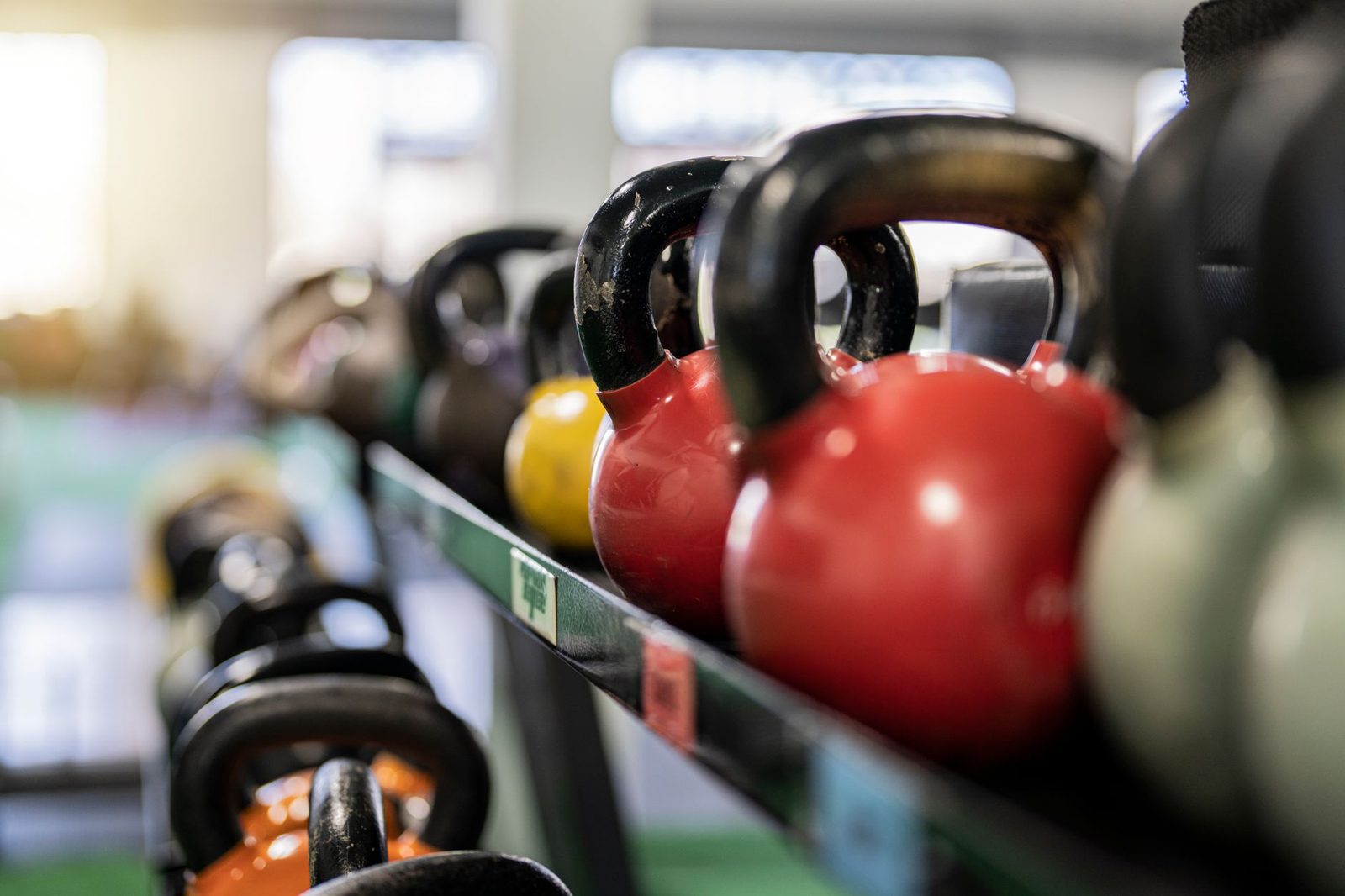
Quick answer: there is no official kettlebell weight chart for men, women or beginners, so choose by exercise and by testing. You will need a heavier bell for two-handed swings and deadlifts than for presses and single-arm work. In research, young men have commonly swung 12 to 16 kg bells, and older adults in one trial started with 8 kg at home. Pick a bell you can move for 8 to 12 clean reps with two or three in reserve, and adjust from there.
Why there is no single answer
Kettlebell weight charts on the internet usually split recommendations by sex and experience, but they are rules of thumb rather than evidence. A 2019 scoping review by Meigh and colleagues noted that there are no authoritative guidelines for prescribing kettlebells in primary care, and that research uses a wide range of approaches. Your starting weight depends on your strength, your training history, the exercise, and your technique, not just your sex.
What we can do is look at what studies used, then apply the same rep-based method that guides all resistance training.
Kettlebell weights used in research
| Study | Participants | Kettlebell weight | Exercise |
|---|---|---|---|
| Lake and Lauder (2012) | Healthy men aged 18 to 27 | 12 kg if under 70 kg body mass; 16 kg if over 70 kg | Two-handed swings, 30 seconds on, 30 seconds off |
| Farrar and colleagues (2010) | College-aged men | 16 kg | Continuous swings for 12 minutes |
| McGill and Marshall (2012) | Male participants | 16 kg | Swings, snatches and carries |
| BELL trial, Meigh and colleagues (2022) | Men and women aged 59 to 79 | 8 kg for home training at the start; bells from 8 to 40 kg allocated by capacity later | Hardstyle kettlebell programme |
Most studies have been done with men, so there is little direct research to guide starting weights for women. The BELL trial is useful here: it included 16 women and 16 men who were previously insufficiently active, and training was individualised, with stronger participants given heavier kettlebells.
Choose by exercise
Different kettlebell movements use very different muscles, so one bell rarely suits everything.
| Exercise | Main muscles | Relative weight |
|---|---|---|
| Deadlift | Hips, thighs, back | Heaviest |
| Two-handed swing | Glutes, hamstrings, back | Heavy |
| Goblet squat | Thighs, glutes | Moderate to heavy |
| Single-arm row | Upper back | Moderate |
| Single-arm swing or clean | Hips, grip, shoulders | Moderate |
| Overhead press | Shoulders, triceps | Light to moderate |
| Turkish get-up | Whole body, shoulder stability | Lightest; start with no weight |
This is why many people eventually own two bells: a lighter one for presses and get-ups, and a heavier one for swings, deadlifts and squats.
The starting weight test
The NHS recommends 8 to 12 reps per set for strengthening exercises, and ACSM’s 2009 guidance recommends that novices use loads that allow 8 to 12 repetitions. ACSM’s 2026 guidance adds that finishing sets with about two or three reps in reserve gives similar results to going to failure, with less fatigue.
- Deadlift first. Learn the hip hinge by deadlifting the bell from between your feet. If you can do 10 smooth reps with a neutral back and clearly have more in reserve, it is likely a reasonable swing weight too.
- Test the goblet squat. Hold the bell at your chest and do 8 to 12 reps. If your chest collapses forward or you cannot hold the bell comfortably, go lighter.
- Test the press separately. Press the bell overhead with one arm. If you cannot do at least 5 controlled reps without leaning back, this bell is too heavy for pressing.
- Be honest about swings. A bell that is too light for swings is less of a problem than one that is too heavy, because good technique matters more than load when you are learning.
How the size of the jump affects progress
Kettlebells usually go up in larger steps than dumbbells. Meigh and colleagues note that competition kettlebells are commonly available from 8 kg to 32 kg in 2 to 4 kg increments. A 4 kg jump is a big percentage increase at lighter weights. ACSM’s 2009 guidance recommends increasing load by 2 to 10% when you can beat your target by one or two reps, so with kettlebells you will often progress by adding reps, sets or harder variations first, then moving up a bell.
That approach is supported by a 2022 study by Plotkin and colleagues, which found that adding reps at a fixed load produced broadly similar results to adding load over eight weeks.
Signs your kettlebell is too heavy
- Your back rounds as you pick it up or at the bottom of a swing.
- You lift the bell with your arms rather than drive it with your hips in a swing.
- The bell drifts away from your body and pulls you forward.
- You lean back to press it overhead.
- You feel it in your lower back or joints rather than in your hips and legs.
Signs it is too light
- You can do 20 or more perfect swings and feel nothing in your glutes and hamstrings.
- Goblet squats feel easy for 15 reps or more.
- Your heart rate barely rises during a set of swings.
A note on older and returning lifters
The BELL trial found that a supervised, progressive hardstyle kettlebell programme was well tolerated by previously inactive adults aged 59 to 79, with very high compliance of 91.5% and four non-serious adverse events. It improved grip strength, walking distance and several measures of strength. Participants were supervised and could choose their own weights, which is a good model: start light, get coaching if you can, and build up gradually. The NHS advises speaking to a GP first if you have not exercised for some time or have medical conditions.
Health note: this article is general education, not medical advice. If you have a health condition, an injury, are pregnant, or have not exercised for a long time, check with your GP or a physiotherapist before starting or changing a training plan, and stop if an exercise causes pain.
Sources
- Meigh et al. (2019) Kettlebell training in clinical practice: a scoping review, BMC Sports Science, Medicine and Rehabilitation (europepmc.org)
- Lake and Lauder (2012) Kettlebell swing training improves maximal and explosive strength, Journal of Strength and Conditioning Research (europepmc.org)
- Farrar, Mayhew and Koch (2010) Oxygen cost of kettlebell swings, Journal of Strength and Conditioning Research (europepmc.org)
- McGill and Marshall (2012) Kettlebell swing, snatch, and bottoms-up carry: back and hip muscle activation, motion, and low back loads, Journal of Strength and Conditioning Research (europepmc.org)
- Meigh et al. (2022) Effects of supervised high-intensity hardstyle kettlebell training on grip strength and health-related physical fitness in insufficiently active older adults: the BELL trial, BMC Geriatrics (europepmc.org)
- How to improve your strength and flexibility, NHS (nhs.uk)
- ACSM position stand: Progression models in resistance training for healthy adults (2009), Medicine and Science in Sports and Exercise (europepmc.org)
- ACSM unveils landmark 2026 resistance training guidelines, American College of Sports Medicine (acsm.org)
- Plotkin et al. (2022) Progressive overload without progressing load? The effects of load or repetition progression on muscular adaptations, PeerJ (europepmc.org)
- Physical activity guidelines for older adults, NHS (nhs.uk)
Leave a Reply