
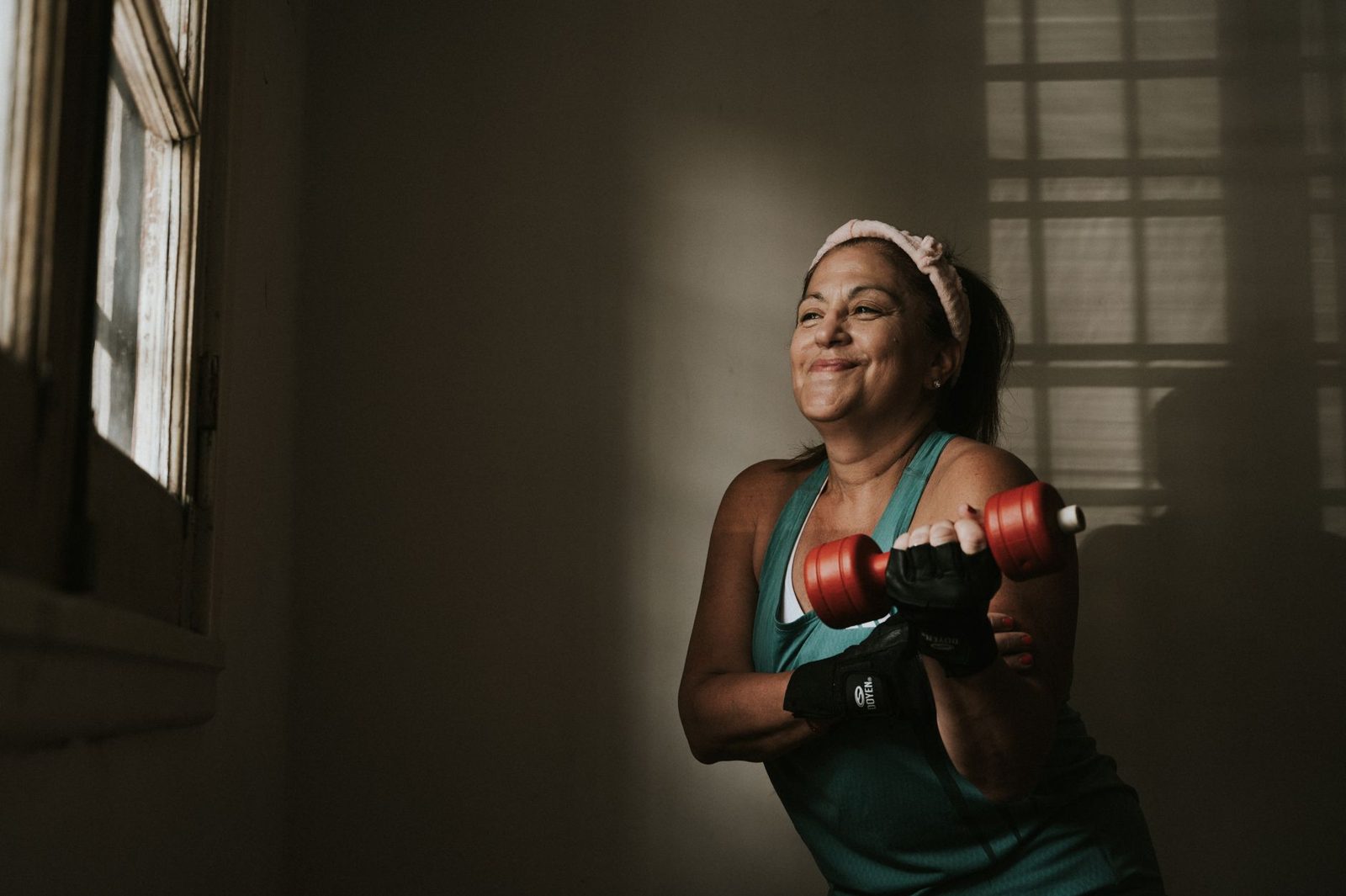
Quick answer: start with two sessions a week that work all your major muscle groups, as the NHS and UK Chief Medical Officers recommend. Pick a weight you can lift for 8 to 12 controlled repetitions, stop a couple of reps short of failure, and do two or three sets per exercise. Learn a handful of basic movement patterns with light dumbbells or a kettlebell, then add weight or reps gradually over weeks.
Why strength training is worth it
The UK Chief Medical Officers advise adults to do muscle strengthening activities on at least two days a week, and state that any strengthening activity is better than none. The NHS explains that strength work helps you keep doing everyday tasks and slows the loss of bone and muscle that comes with ageing.
A 2022 meta-analysis of cohort studies in the British Journal of Sports Medicine, by Momma and colleagues, found that muscle strengthening activities were associated with a 10 to 17% lower risk of all-cause mortality, cardiovascular disease, total cancer, diabetes and lung cancer. The largest risk reduction for several outcomes appeared at roughly 30 to 60 minutes a week. These are associations from observational studies rather than proof of cause, but they line up with the official advice.
How much to do
You do not need a complicated plan. ACSM’s 2026 position stand, based on 137 systematic reviews, emphasises that regular participation matters more than a perfect programme, and that training all major muscle groups at least twice a week is the priority.
| Variable | Beginner starting point | Where it comes from |
|---|---|---|
| Sessions per week | 2, on non-consecutive days | NHS and UK CMO guidelines; ACSM 2009 suggests 2 to 3 for novices |
| Muscle groups | Legs, hips, back, abdomen, chest, shoulders and arms | NHS guidelines |
| Repetitions per set | 8 to 12 | NHS; ACSM 2009 novice guidance |
| Sets per exercise | At least 2, 3 for more benefit | NHS |
| Effort | Finish each set with about 2 to 3 reps left in the tank | ACSM 2026 |
| Progression | Add 2 to 10% load when you beat your target reps by 1 to 2 | ACSM 2009 |
The NHS describes muscle strengthening as work that takes your muscles to the point where you may need a short rest before continuing. That is a good practical test of whether a set was hard enough.
Choosing your first equipment
For most people starting at home, a small range of dumbbells, one or two kettlebells, or both, will cover every movement below. The NHS even suggests filled water bottles as light weights for gentle strength exercises, which shows how little you need at the very start. As you get stronger you will need heavier loads for your legs and back than for your shoulders and arms, so it helps to plan for a few different weights rather than a single pair.
Learn six movement patterns
Rather than memorising dozens of exercises, learn the basic patterns. Each one has a simple free weight version.
- Squat: goblet squat, holding one dumbbell or kettlebell at your chest.
- Hinge: Romanian deadlift with dumbbells, pushing the hips back with a long, neutral spine.
- Lunge or single leg: split squat or reverse lunge holding dumbbells at your sides.
- Push: dumbbell floor press or bench press, and a standing or seated overhead press.
- Pull: one-arm dumbbell row, supported on a bench or sturdy chair.
- Carry and brace: a farmer’s carry, walking tall with a weight in each hand.
ACSM’s 2009 progression guidance recommends doing larger muscle group and multi-joint exercises before smaller, single-joint ones within a session, so put squats, hinges and rows before curls or raises.
A simple first month
- Weeks 1 and 2: practise each pattern with a light load for 2 sets of 10. Focus on smooth, controlled reps and a full, comfortable range of movement.
- Weeks 3 and 4: move to 3 sets of 8 to 12. Choose a weight that leaves about two or three reps in reserve at the end of each set.
- From week 5: when you can do two more reps than your target on every set, increase the load slightly, or add a rep or a set.
The UK Chief Medical Officers note that starting at low durations and intensities and building up as your body adjusts is the safest way to become more active, and the NHS advises building up gradually over a period of weeks.
How hard should it feel?
Many beginners either stop far too early or push every set to complete failure. ACSM’s 2026 guidance says that stopping roughly two to three repetitions short of failure delivers similar strength and muscle gains to maximal-effort sets, with less fatigue. A 2024 study by Refalo and colleagues found that trained lifters could predict their reps in reserve accurately to within about one rep, so it is a skill that improves with practice. If you are new, film a set or ask yourself honestly how many more good reps you could have done.
Rest between sets
ACSM’s 2009 position stand suggests rest periods of one to two minutes for moderate loads aimed at muscle growth, and longer rests of three to five minutes for heavy strength work. In a 2016 trial by Schoenfeld and colleagues, trained men who rested three minutes between sets gained more strength and, in some muscles, more size than those who rested one minute. For beginners, resting until you feel ready to do the next set with good form is a sensible rule.
Common beginner mistakes
- Too heavy, too soon: if your technique changes during a set, the weight is too heavy for now.
- Skipping muscle groups: legs and back often get neglected. Cover every pattern each week.
- Constantly changing the plan: repeat the same exercises long enough to see progress.
- Rushing the lowering phase: control the weight on the way down as well as up.
- Cluttered floor: put weights away after each set, especially if children or pets are around.
Keeping it going
Strength training is most useful when it becomes a habit. Keep a simple log of the exercises, weights and reps you do each session. Seeing the numbers creep up over months is one of the best motivators there is, and it tells you exactly when to progress.
Health note: this article is general education, not medical advice. If you have a health condition, an injury, are pregnant, or have not exercised for a long time, check with your GP or a physiotherapist before starting or changing a training plan, and stop if an exercise causes pain.
Sources
- Physical activity guidelines for adults aged 19 to 64, NHS (nhs.uk)
- How to improve your strength and flexibility, NHS (nhs.uk)
- Strength exercises, NHS (nhs.uk)
- UK Chief Medical Officers’ physical activity guidelines (2019), Department of Health and Social Care (gov.uk)
- Momma et al. (2022) Muscle-strengthening activities are associated with lower risk and mortality in major non-communicable diseases: a systematic review and meta-analysis of cohort studies, British Journal of Sports Medicine (europepmc.org)
- ACSM unveils landmark 2026 resistance training guidelines, American College of Sports Medicine (acsm.org)
- ACSM position stand: Progression models in resistance training for healthy adults (2009), Medicine and Science in Sports and Exercise (europepmc.org)
- Refalo et al. (2024) Accuracy of intraset repetitions-in-reserve predictions during the bench press exercise, Journal of Strength and Conditioning Research (europepmc.org)
- Schoenfeld et al. (2016) Longer interset rest periods enhance muscle strength and hypertrophy in resistance-trained men, Journal of Strength and Conditioning Research (europepmc.org)
Leave a Reply