
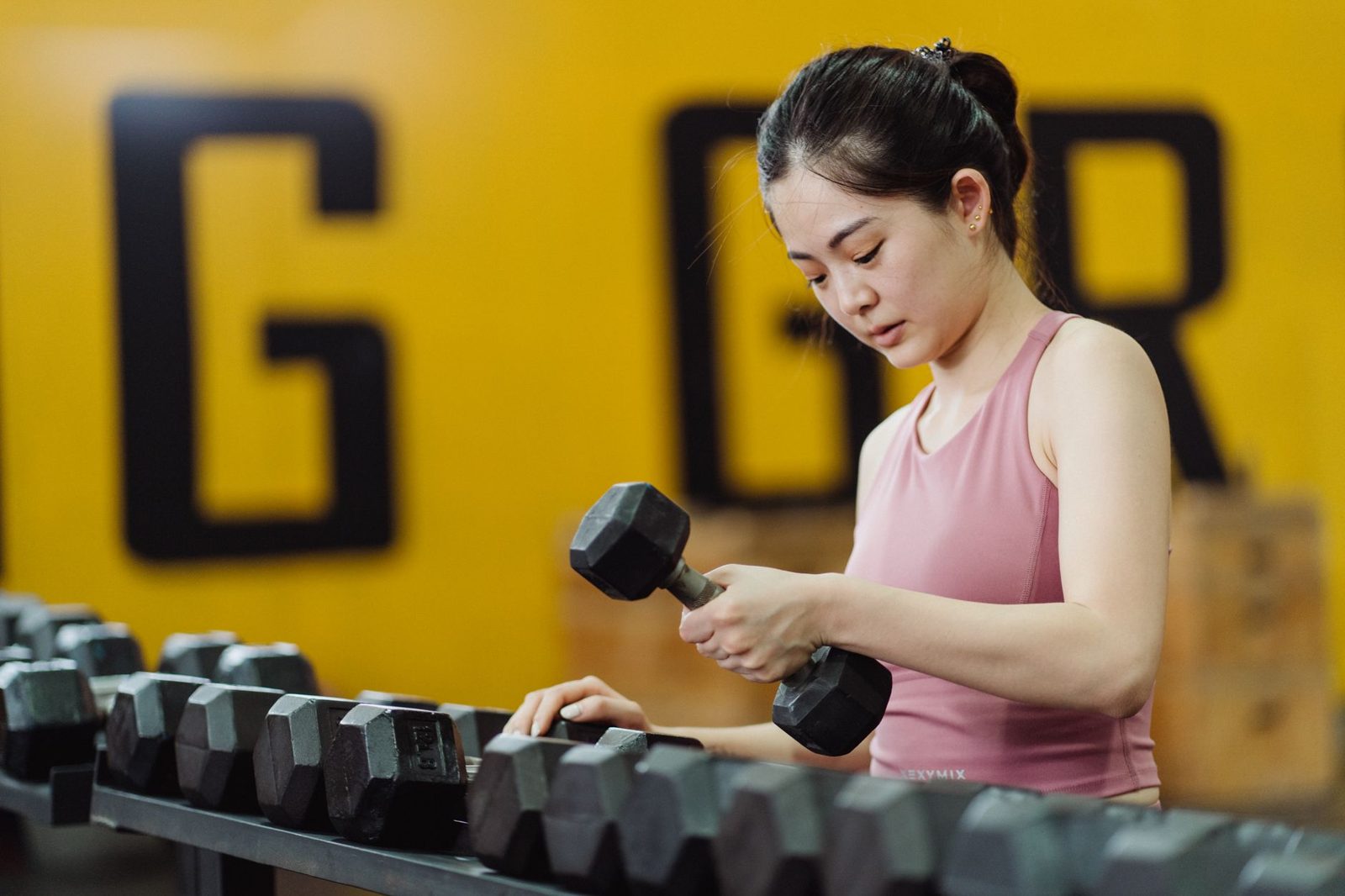
Quick answer: do this full-body dumbbell workout twice a week on non-consecutive days. It covers squat, hinge, lunge, push, pull and core, matching the NHS advice to work all major muscle groups on at least two days a week. Do 2 to 3 sets of 8 to 12 reps for each exercise, finish sets with two or three reps in reserve, rest one to two minutes, and add reps or weight as you get stronger.
Who this workout is for
This plan suits adults who are new to weights, or returning after a break, and who have a few pairs of dumbbells or an adjustable set at home. It takes about 40 to 50 minutes including a warm-up. The UK Chief Medical Officers recommend muscle strengthening activities on at least two days a week, and this plan meets that with two sessions.
Before you start
- Clear enough space to step forward and back and to lie on the floor.
- Have a stable bench or a solid chair without wheels, as the NHS advises for seated exercises.
- Pick a light, medium and heavy pair if you can. Your legs will usually handle more than your shoulders.
- Warm up for five minutes: march or walk briskly, circle your arms and hips, and do a few bodyweight squats.
The workout
ACSM’s 2009 position stand recommends doing large muscle group and multi-joint exercises before smaller, single-joint ones, so the order below starts with the biggest movements.
| Order | Exercise | Sets x reps | Rest | Main muscles |
|---|---|---|---|---|
| 1 | Goblet squat | 2 to 3 x 8 to 12 | 90 seconds | Thighs, glutes |
| 2 | Dumbbell Romanian deadlift | 2 to 3 x 8 to 12 | 90 seconds | Hamstrings, glutes, back |
| 3 | One-arm dumbbell row | 2 to 3 x 8 to 12 each side | 60 to 90 seconds | Upper back, lats, biceps |
| 4 | Dumbbell floor or bench press | 2 to 3 x 8 to 12 | 60 to 90 seconds | Chest, shoulders, triceps |
| 5 | Reverse lunge | 2 x 8 to 10 each leg | 60 to 90 seconds | Thighs, glutes, balance |
| 6 | Seated or standing overhead press | 2 x 8 to 12 | 60 seconds | Shoulders, triceps |
| 7 | Farmer’s carry | 2 to 3 x 30 to 40 metres or 30 seconds | 60 seconds | Grip, trunk, posture |
How to do each exercise
Goblet squat
Hold one dumbbell vertically against your chest. Stand with feet about shoulder-width apart, sit down between your hips as far as is comfortable while keeping your chest up and heels down, then stand up.
Romanian deadlift
Hold a dumbbell in each hand in front of your thighs. With soft knees, push your hips back and slide the weights down your legs while keeping your back long and neutral. Stop when you feel a stretch in the back of your thighs, then drive your hips forward to stand tall.
One-arm row
Place one hand and knee on a bench, or brace a hand on a sturdy chair with a split stance. Let the dumbbell hang, then pull it towards your hip, keeping your shoulders level. Lower with control.
Floor or bench press
Lie on your back with a dumbbell in each hand above your chest. Lower them to the sides of your chest, elbows at roughly 45 degrees from your body, then press up. The floor version limits range, which many beginners find comfortable.
Reverse lunge
Hold dumbbells at your sides. Step one foot back and lower until both knees are bent, then push through the front foot to return. Hold on to something for balance at first if needed.
Overhead press
Start with the dumbbells at shoulder height. Brace your trunk and press them overhead without leaning back, then lower with control. Sitting with back support makes this easier to learn.
Farmer’s carry
Pick up a heavy pair using good lifting technique, stand tall with shoulders back, and walk slowly and steadily. Put them down carefully.
How hard and how much rest
The NHS describes muscle strengthening as work that takes muscles to the point where you may need a short rest before continuing. ACSM’s 2026 guidance adds that stopping two to three reps short of failure gives similar results to going to failure, with less fatigue. ACSM’s 2009 guidance suggests one to two minutes of rest for this kind of moderate-load training. Rest until you can do the next set with good form.
Eight-week progression
| Weeks | Focus | Sets | Progression rule |
|---|---|---|---|
| 1 to 2 | Learn the movements with light weights | 2 per exercise | Smooth reps, full comfortable range |
| 3 to 4 | Find your working weights | 2 to 3 | Finish sets with 2 to 3 reps in reserve |
| 5 to 8 | Build strength | 3 | When you hit 12 reps on every set, increase the weight |
ACSM’s 2009 guidance recommends a 2 to 10% load increase when you can do one or two reps over your target. If the next dumbbell is too big a jump, keep adding reps first; Plotkin and colleagues found in 2022 that adding reps at a fixed load worked about as well as adding load over eight weeks.
What results to expect
A review by Westcott in Current Sports Medicine Reports summarised research showing that resistance training can improve physical performance, movement control, walking speed and functional independence, and that ten weeks of training may increase lean weight and reduce fat weight. Individual results vary, but most beginners notice that everyday tasks feel easier within the first couple of months.
Tips for success
- Log every session so you know what to lift next time.
- Keep the same exercises for at least eight weeks before changing them.
- Add aerobic activity on other days; the NHS notes that strength work is in addition to the 150 minutes of moderate aerobic activity adults should aim for each week.
- Put dumbbells away after every set to keep the floor clear.
Health note: this article is general education, not medical advice. If you have a health condition, an injury, are pregnant, or have not exercised for a long time, check with your GP or a physiotherapist before starting or changing a training plan, and stop if an exercise causes pain.
Sources
- Physical activity guidelines for adults aged 19 to 64, NHS (nhs.uk)
- How to improve your strength and flexibility, NHS (nhs.uk)
- Strength exercises, NHS (nhs.uk)
- UK Chief Medical Officers’ physical activity guidelines (2019), Department of Health and Social Care (gov.uk)
- ACSM position stand: Progression models in resistance training for healthy adults (2009), Medicine and Science in Sports and Exercise (europepmc.org)
- ACSM unveils landmark 2026 resistance training guidelines, American College of Sports Medicine (acsm.org)
- Plotkin et al. (2022) Progressive overload without progressing load? The effects of load or repetition progression on muscular adaptations, PeerJ (europepmc.org)
- Westcott (2012) Resistance training is medicine: effects of strength training on health, Current Sports Medicine Reports (europepmc.org)
Leave a Reply