
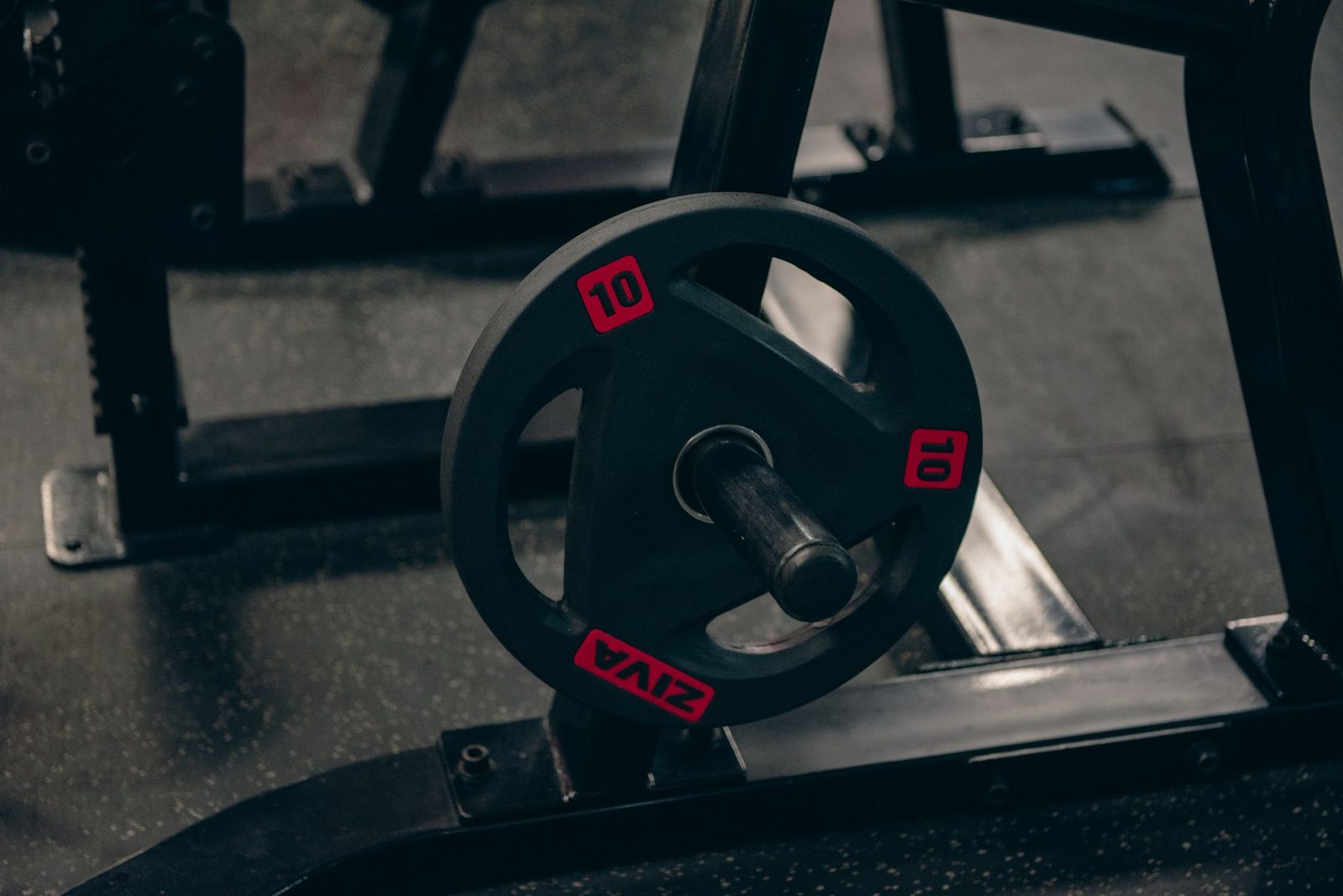
Quick answer: for general strength and muscle growth, free weights and machines both work. A 2023 systematic review and meta-analysis found no significant difference in muscle growth between the two, and strength gains were largely specific to the equipment people trained with. Free weights ask more of your balance and coordination and need very little space, which is why they suit home training so well. The best choice is the one you will use consistently, with good technique.
What counts as a free weight?
A free weight is any load you hold and control yourself, with nothing guiding its path. That means dumbbells, kettlebells, barbells and weight plates. A machine, by contrast, fixes the movement to a track, a cable or a lever, so the equipment rather than your body decides where the weight travels.
That single difference, who controls the path of the load, explains most of the pros and cons below. With a free weight, your muscles have to lift the load and also keep it steady in every direction. With a machine, a lot of that stabilising work is done for you.
What the evidence says
The most useful summary of direct comparisons is a 2023 systematic review and meta-analysis by Haugen and colleagues, published in BMC Sports Science, Medicine and Rehabilitation. It pooled 13 studies with 1,016 adult participants who trained for at least six weeks with either free weights or machines.
- Muscle growth: the review found no significant difference in hypertrophy between free-weight and machine groups.
- Strength: when strength was tested with free weights, the free-weight groups improved significantly more. When it was tested on machines, the machine groups tended to improve more. In other words, you get best at the thing you practise.
- Jumping: there was no significant difference in countermovement jump performance.
The authors concluded that, for strength and muscle size, the choice between free weights and machines comes down to individual preferences and goals. They also noted that free weights involve more degrees of freedom, which can mean a steeper learning curve for complete beginners.
The American College of Sports Medicine (ACSM) reached a similar view in its 2026 resistance training position stand, which drew on 137 systematic reviews. It reported that the type of equipment, machines versus free weights, did not consistently change outcomes for the average healthy adult. The biggest gain, according to ACSM, comes from moving from no resistance training to any resistance training, and training all major muscle groups at least twice a week.
Side by side comparison
| Factor | Free weights | Machines |
|---|---|---|
| Muscle growth | Similar to machines in pooled research | Similar to free weights in pooled research |
| Strength carryover | Greater when strength is tested with free weights | Tends to be greater when tested on machines |
| Balance and coordination demand | Higher, you stabilise the load yourself | Lower, the path is fixed |
| Learning curve | Steeper for complete beginners | Gentler |
| Exercise variety | Very wide from a small set of equipment | Usually one or two movements per machine |
| Space needed at home | Small, a set of dumbbells or a kettlebell fits in a corner | Large, each station needs floor space |
| Unilateral (one side) training | Easy with dumbbells and kettlebells | Possible on some machines only |
Why free weights feel harder
If you have ever pressed a pair of dumbbells and found you could not handle as much as on a barbell or machine, that is normal. A 2011 study by Saeterbakken and colleagues compared chest pressing on a Smith machine, a barbell and dumbbells in trained men. The dumbbell one-repetition maximum was about 14% lower than the Smith machine and 17% lower than the barbell. Chest and front shoulder muscle activity was similar across the three, while biceps activity rose as the stability demand increased.
Haugen and colleagues offer an explanation: when a movement is less stable, muscles prioritise keeping the load steady over producing force in the direction of the lift. So a lighter dumbbell can still be a hard, productive set.
The case for free weights at home
For a home trainer, free weights have some clear practical strengths:
- Space and versatility: a set of dumbbells or one or two kettlebells can train every major muscle group the NHS lists, legs, hips, back, abdomen, chest, shoulders and arms.
- Real-world carryover: because strength gains are specific to how you train, lifting and controlling free loads is close to how you lift shopping, children or bags in daily life.
- Working each side: dumbbells and kettlebells let you train one arm or one leg at a time, which makes differences between sides easy to spot.
- Room to progress: you can make an exercise harder by adding weight, reps, sets or control, without needing new equipment for every movement.
When a machine might suit you better
Haugen and colleagues suggested that machines could suit inexperienced lifters because the movement is simpler and more stable. If you have poor balance, are returning after a long break, or struggle to learn a movement, a guided option or very light free weights with coaching can be a sensible start. Many people use both.
On safety, the same review noted that cross-sectional studies report more injuries with free weights, but questioned whether free weights actually cause more injuries, because there are few long-term experimental studies. An analysis of US emergency department data by Kerr and colleagues found that 90.4% of weight training injuries involved free weights, and that the most common mechanism was weights dropping on the person. That points to handling, storage and loading habits rather than the exercises themselves, which is where good technique and a tidy training space matter most.
How to decide
- Start with your goal. If you want to get better at lifting free loads, or train at home, free weights are a natural fit. If you compete in a sport that uses barbells, specificity matters and you should practise those lifts.
- Be honest about skill. Learn movements with a light load first. Technique before weight.
- Think about adherence. ACSM’s 2026 guidance stresses that programmes should reflect personal goals, enjoyment and safety so that people stick with them.
- Cover the basics. Whatever you choose, aim to work all major muscle groups on at least two days a week, as the UK Chief Medical Officers recommend.
The bottom line
There is no winner for everyone. The research shows similar muscle growth, and strength that is specific to how you train. Free weights give you a lot of training from a little equipment, build the coordination that comes with controlling a load, and fit easily into a home. Learn the movements well, progress gradually, and keep your training area organised.
Health note: this article is general education, not medical advice. If you have a health condition, an injury, are pregnant, or have not exercised for a long time, check with your GP or a physiotherapist before starting or changing a training plan, and stop if an exercise causes pain.
Sources
- Haugen et al. (2023) Effect of free-weight vs. machine-based strength training on maximal strength, hypertrophy and jump performance: a systematic review and meta-analysis, BMC Sports Science, Medicine and Rehabilitation (pmc.ncbi.nlm.nih.gov)
- ACSM unveils landmark 2026 resistance training guidelines, American College of Sports Medicine (acsm.org)
- Saeterbakken, van den Tillaar and Fimland (2011) A comparison of muscle activity and 1-RM strength of three chest-press exercises with different stability requirements, Journal of Sports Sciences (europepmc.org)
- Kerr, Collins and Comstock (2010) Epidemiology of weight training-related injuries presenting to United States emergency departments, 1990 to 2007, American Journal of Sports Medicine (europepmc.org)
- Physical activity guidelines for adults aged 19 to 64, NHS (nhs.uk)
- UK Chief Medical Officers’ physical activity guidelines (2019), Department of Health and Social Care (gov.uk)
Leave a Reply