
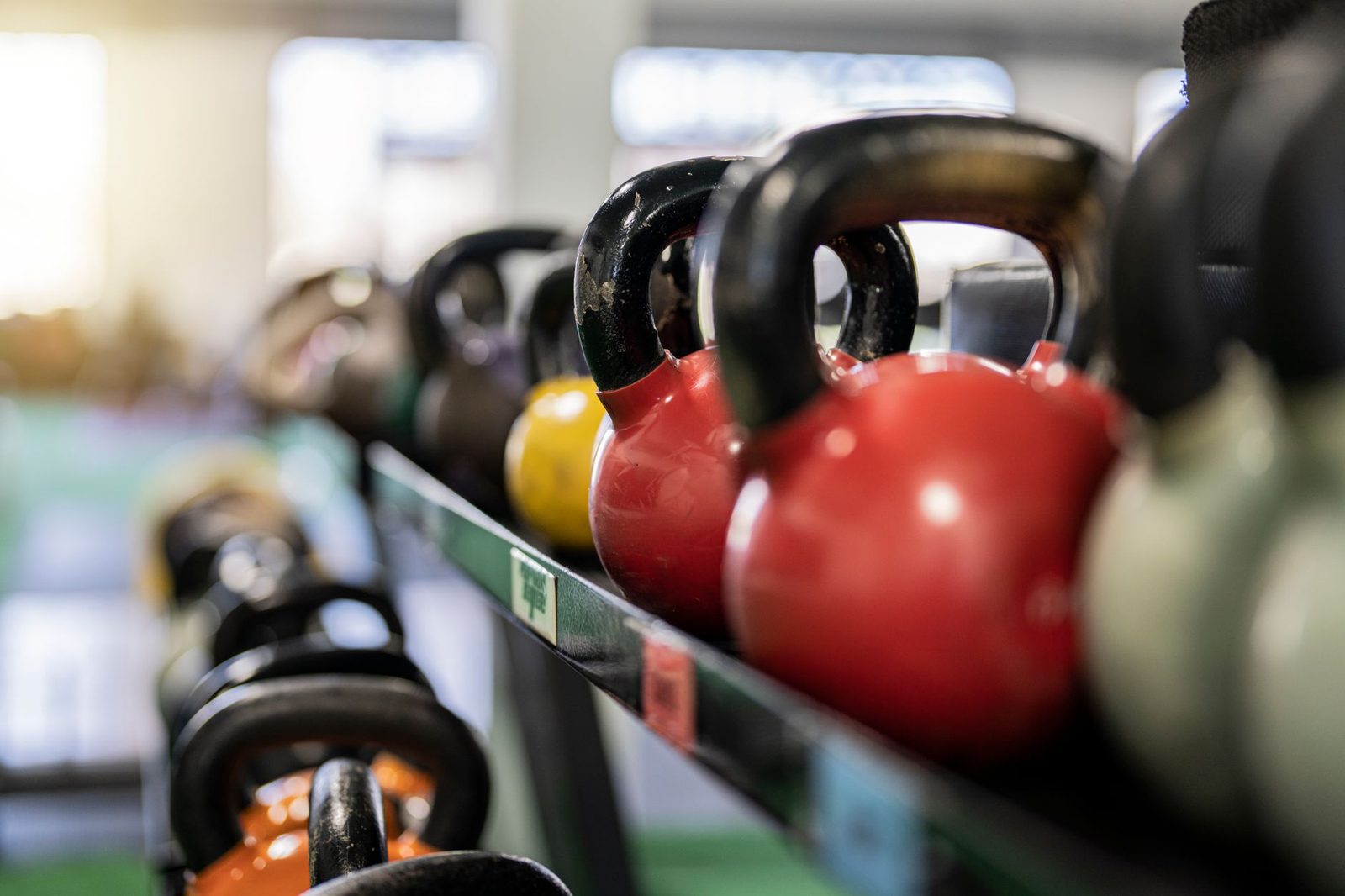
Quick answer: competition kettlebells are steel and have the same outer dimensions at every weight, so your technique and rack position stay the same as you move up. Traditional cast iron kettlebells get bigger as they get heavier and often have thicker handles. Competition bells suit kettlebell sport and high-repetition work; cast iron bells suit general strength and hardstyle training. Both work well at home.
Two kinds of kettlebell
A 2019 scoping review by Meigh and colleagues, published in BMC Sports Science, Medicine and Rehabilitation, describes the two main designs clearly. Kettlebell sport uses competition kettlebells of standardised dimensions made of steel, most commonly available from 8 kg to 32 kg in 2 to 4 kg increments. Kettlebells described as traditional in shape are typically made from cast iron, with dimensions increasing with weight.
The review also notes that kettlebells are now widely available in many construction materials, from 2 kg to 92 kg.
Comparison table
| Feature | Competition kettlebell | Cast iron kettlebell |
|---|---|---|
| Material | Steel | Cast iron |
| Size | Same outer size at every weight | Grows with the weight |
| Handle | Usually consistent and relatively slim | Varies, often thicker on heavier bells |
| Weight range | Commonly 8 to 32 kg | Very light to very heavy |
| Weight steps | Commonly 2 to 4 kg | Varies by range |
| Best for | Kettlebell sport, high reps, consistent technique | General strength, hardstyle training, goblet work |
Why consistent size matters
In kettlebell sport, the main lifts are the jerk and the snatch, performed for repetitions within timed events, as Meigh and colleagues describe. Because a competition bell’s size and handle stay the same from light to heavy, the bell sits in the same place on your forearm in the rack and overhead positions whatever you are lifting. When you move up a weight, only the load changes, not your hand position or the way the bell rests on your arm.
With cast iron bells, a heavier bell is physically larger. It may sit differently against your forearm, and the handle may be thicker and further from the body of the bell. Some lifters notice they need to adjust their technique slightly each time they move up.
Kettlebell sport and hardstyle
Meigh and colleagues explain that only a small number of kettlebell styles are widely recognised, including sport style and hardstyle. Kettlebell sport, also known as Girevoy sport, originated in Eastern Europe in 1948. The International Union of Kettlebell Lifting World Championship in October 2018 attracted more than 500 competitors from 32 countries.
The review lists six fundamental hardstyle techniques: the swing, clean, press, squat, snatch and Turkish get-up, and notes that the two-handed swing is the most researched. Of the 99 publications in the scoping review, 33 studies explicitly used hardstyle techniques and 4 investigated kettlebell sport, so most of the research you will read about uses a hardstyle approach. Either type of bell can be used for hardstyle work.
Which type suits you?
Choose competition kettlebells if:
- You are interested in kettlebell sport or high-repetition jerks and snatches.
- You want your technique to stay identical as you move up in weight.
- You plan to buy several bells over time and want a matched set.
Choose cast iron kettlebells if:
- You mainly want general strength and conditioning: swings, goblet squats, deadlifts, rows and presses.
- You want lighter bells for beginners or mobility work, where cast iron is often available in smaller sizes.
- You like thicker handles, which can be comfortable for two-handed swings and goblet holds.
Features to check on either type
- Handle finish: it should be smooth, without sharp seams or burrs that tear your hands.
- Window size: the gap between the handle and the ball should fit your hand, or both hands for two-handed swings.
- Flat base: a flat bottom keeps the bell stable on the floor.
- Accurate weight: the marked weight should match the actual weight.
- Coating: bare metal, paint and powder coat all feel different. A lightly textured finish can help grip; a slick one may slip when your hands sweat.
Care and storage
| Task | How often | Why |
|---|---|---|
| Wipe the handle | After every session | Sweat and chalk build-up make the handle slippery and speed up rust |
| Check for cracks, burrs and chips | Monthly | Sharp edges can damage hands; cracks are a safety risk |
| Store dry and off the floor where possible | Always | Iron and steel can rust in damp garages and sheds |
| Keep away from children | Always | Research found young children were more prone to hand injuries from weights |
That last point comes from an analysis by Kerr and colleagues of weight training injuries in US emergency departments, which found that weights dropping on people was the most common cause of injury and that children aged 12 and under had a larger share of hand injuries. Store bells on a low shelf or rack, not at head height.
Building a set over time
Most people do not need a full range of bells at once. A common approach is to start with one bell you can deadlift and swing comfortably, add a lighter one for presses and get-ups, then add heavier bells as your strength improves. For reference, research on young men has typically used 12 to 16 kg bells for swings, and the BELL trial in adults aged 59 to 79 started participants with an 8 kg bell for home training before allocating heavier bells by capacity. Whichever design you choose, buying from the same range keeps handles and finishes consistent.
Safe lifting from the floor
Whatever type you choose, pick bells up with good handling technique. The Health and Safety Executive advises keeping a load close to your body, avoiding twisting, and not lifting more than you can easily manage. For kettlebells, that means hinging at the hips to pick the bell up, rather than reaching and rounding your back.
The bottom line
Competition kettlebells offer consistency for sport and high-repetition lifting. Cast iron kettlebells are versatile for general strength and conditioning. Neither is better for everyone. Choose based on how you train, learn the basics with a manageable weight, and look after your bells so they last for years.
Health note: this article is general education, not medical advice. If you have a health condition, an injury, are pregnant, or have not exercised for a long time, check with your GP or a physiotherapist before starting or changing a training plan, and stop if an exercise causes pain.
Sources
- Meigh et al. (2019) Kettlebell training in clinical practice: a scoping review, BMC Sports Science, Medicine and Rehabilitation (europepmc.org)
- Lake and Lauder (2012) Kettlebell swing training improves maximal and explosive strength, Journal of Strength and Conditioning Research (europepmc.org)
- Meigh et al. (2022) Effects of supervised high-intensity hardstyle kettlebell training on grip strength and health-related physical fitness in insufficiently active older adults: the BELL trial, BMC Geriatrics (europepmc.org)
- Kerr, Collins and Comstock (2010) Epidemiology of weight training-related injuries presenting to United States emergency departments, 1990 to 2007, American Journal of Sports Medicine (europepmc.org)
- Good handling technique, Health and Safety Executive (hse.gov.uk)
Leave a Reply