
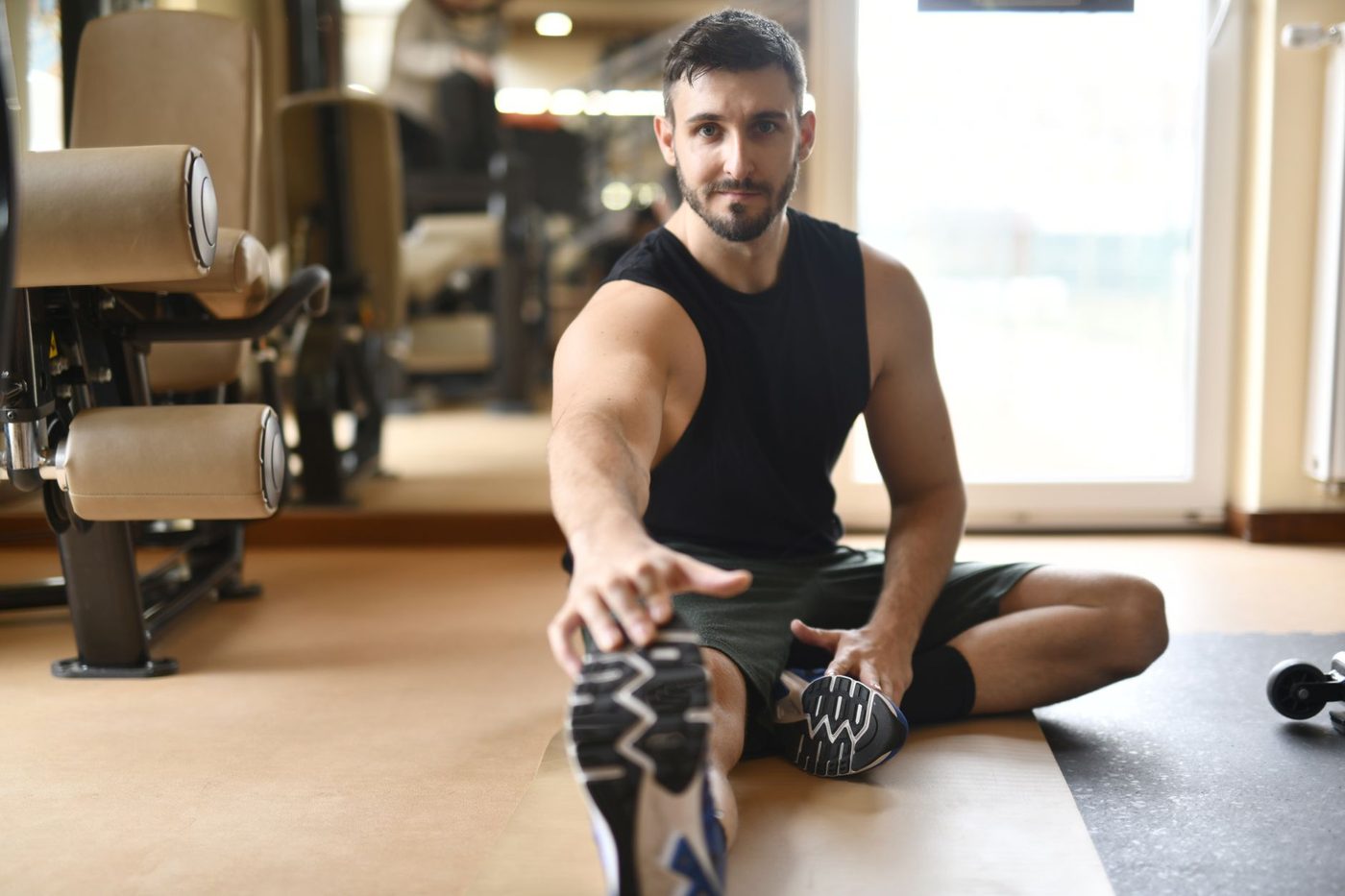
Illustration: a lifter has just put down the dumbbells after a session and has about five minutes before leaving. What do the sources say about spending them stretching? Two NHS pages describe stretching routines, and two research papers look at what stretching does. This guide sets them side by side. It is general information for healthy adults, not medical advice, and none of the sources is specific to dumbbell or kettlebell training. The NHS pages were read on 27 October 2026.
What the NHS cool-down contains
The NHS page “How to stretch after exercising” (page last reviewed 16 March 2026) describes its routine as a way to cool down after a workout, to gradually relax, improve flexibility and slow the heart rate. It says the gentle stretches should take about 5 minutes, and that you can spend more time if you feel the need.
The routine has five stretches, each held for 15 to 20 seconds: buttock, hamstring, inner thigh, calf and thigh. All five work the lower body. The page says that if you have an injury, a medical condition or are pregnant, you may need to make changes to some stretches, and to talk to a physiotherapist or healthcare professional about which ones are right for you.
A second NHS routine, with different holds
The NHS “Flexibility exercises” page (page last reviewed 20 November 2023) is a different routine, which says not to worry if you have not done much exercise for a while. It lists neck rotation, a neck stretch, a sideways bend and a calf stretch, with instructions such as moving “as far as is comfortable”, and says to build up slowly. It says to try to do the exercises at least twice a week and to combine them with its sitting, balance and strength routines.
The hold times differ from the cool-down page: 5 seconds for the neck stretch and 2 seconds for the sideways bend, against 15 to 20 seconds for each cool-down stretch. The pages describe different routines, and each figure is given as it appears on its own page.
What the Cochrane review tested
A Cochrane review published in 2011, with searches to early 2010, asked whether stretching before or after exercise affects delayed-onset muscle soreness. It included 12 randomised or quasi-randomised studies. One was a large field trial with 2,377 participants, 1,220 of whom were allocated to stretching. The other 11 were small, with 10 to 30 participants in the stretch condition. All were at moderate or high risk of bias, and the quality of the evidence was low to moderate.
- After exercise only: the pooled estimate was a reduction in soreness one day later of about one point on a 100-point scale (4 studies; the 95% confidence interval ran from a 6.88-point reduction to a 4.79-point increase).
- Before and after, in the large trial: peak soreness over a week was about four points lower on the same scale, which the authors call statistically significant but very small.
The authors concluded that stretching before, after, or before and after exercise does not produce clinically important reductions in delayed-onset muscle soreness in healthy adults.
What 20 experts agreed in 2025
A Delphi consensus statement in the Journal of Sport and Health Science used a panel of 20 experts who reviewed existing systematic reviews, with at least 80% agreement required. The panel agreed that chronic and acute stretching improves range of motion (although alternatives exist) and reduces muscle stiffness, which may not always be desirable. It agreed that chronic stretching may promote vascular health, but that more research is warranted.
It also agreed that stretch training does not contribute substantively to muscle growth, does not serve as an all-encompassing injury prevention strategy, does not improve posture, and does not acutely enhance post-exercise recovery. A consensus statement is expert agreement based on reviews, not a new trial.
Does stretching count towards the weekly target?
The NHS guidelines for adults aged 19 to 64 (last reviewed 22 May 2024) say adults should aim to do strengthening activities that work all the major muscle groups (legs, hips, back, abdomen, chest, shoulders and arms) on at least 2 days a week. Effort matters: the page says to do them to the point where you need a short rest before repeating the activity. Its examples include lifting weights, working with resistance bands, exercises that use your own body weight, yoga, pilates and tai chi. Stretching routines are not among the examples. The guide to what counts as muscle-strengthening activity compares the NHS and CMO lists in full.
The bottom line
The NHS cool-down routine takes about 5 minutes and holds each of five lower-body stretches for 15 to 20 seconds. The 2011 Cochrane review found no clinically important reduction in delayed-onset muscle soreness from stretching in healthy adults, and the 2025 Delphi panel agreed that stretching improves range of motion but does not acutely enhance post-exercise recovery. Anyone with an injury, a medical condition or pregnancy is pointed by the NHS to a physiotherapist or healthcare professional. For the other end of the session, see the guide to warming up for dumbbell and kettlebell sessions.
Sources
- How to stretch after exercising, NHS, page last reviewed 16 March 2026 (nhs.uk)
- Flexibility exercises, NHS, page last reviewed 20 November 2023 (nhs.uk)
- Physical activity guidelines for adults aged 19 to 64, NHS, page last reviewed 22 May 2024 (nhs.uk)
- Stretching to prevent or reduce muscle soreness after exercise, Cochrane Database of Systematic Reviews, 2011 (pubmed.ncbi.nlm.nih.gov)
- Practical recommendations on stretching exercise: A Delphi consensus statement of international research experts, Journal of Sport and Health Science, 2025 (pubmed.ncbi.nlm.nih.gov)
Leave a Reply